
Safe packaging and transport of nuclear substances
CNSC Website User Survey
Share your experience in using our website by completing our survey. The survey should take you less than 10 minutes to complete.
The Canadian Nuclear Safety Commission (CNSC) and Transport Canada jointly regulate the packaging and transport of nuclear substances in Canada. The CNSC is also responsible for certifying transport packages when required, and issuing transport licences under specific circumstances.
Overview
Over 750,000 shipments containing different nuclear substances are transported to, from and within Canada every year. The majority of these are routine shipments of nuclear substances used for medical, industrial, academic and research, and commercial applications. These shipments include:
- medical isotopes
- products for consumer use, like smoke detectors
- radiation devices such as portable gauges and exposure devices
- uranium ore
- fuel for nuclear power plants
- nuclear waste
Nuclear substances are transported in packages that are selected based on the nature, form and quantity and/or activity of the substances. All package types must comply with general design requirements to ensure that they can be:
- handled safely and easily
- secured properly
- able to withstand routine transport conditions
Key points
Note these key points about the packaging and transport of nuclear substances:
- Transport safety is jointly regulated by the CNSC and Transport Canada.
- Packaging standards are based on international guidelines.
- Packages used for higher-risk nuclear substances must be certified by the CNSC.
- Transport licences are required in specific cases.
- All parties involved in the packaging and transport of nuclear substances have defined responsibilities to ensure safe handling, documentation and emergency preparedness.
- All accidents and dangerous occurrences must be reported immediately to the CNSC.
Ensuring the safe transport of nuclear substances
The CNSC shares responsibility with Transport Canada for ensuring the safe transport of nuclear substances. This means that the transport of nuclear substances is subject to the requirements of the following regulations:
- CNSC’s Packaging and Transport of Nuclear Substances Regulations, 2015 (PTNSR 2015)
- Transport Canada’s Transportation of Dangerous Goods Regulations (TDG Regulations)
The PTNSR 2015 relies on the International Atomic Energy Agency (IAEA) SSR-6, Regulations for the Safe Transport of Radioactive Material, 2018 Edition through an ambulatory reference. An ambulatory reference is the incorporation of a document into a regulation, even as it is changed over time. This ensures that the PTNSR 2015 will continue to align with international regulations as they are modified.
The PTNSR 2015 covers all aspects of the packaging and transport of nuclear substances. It also covers all phases of transport, from the preparation of packages for shipment to the package unloading at the destination.
The CNSC published REGDOC-2.14.1, Volume I: Information Incorporated by Reference in Canada’s Packaging and Transport of Nuclear Substances Regulations, 2015. It was published to help the regulated community comply with the PTNSR 2015. REGDOC-2.14.1 links provisions in the regulations to relevant content in:
- the IAEA Regulations
- the Nuclear Safety and Control Act
- other CNSC regulations
- TDG Regulations and other related information
The TDG Regulations provide the requirements for the transport of all classes of dangerous goods. The PTNSR 2015 is concerned solely with nuclear substances. Both regulations ensure the:
- health, safety and security of people
- protection of the environment
Both the PTNSR 2015 and the TDG Regulations apply to the packaging and transport of nuclear substances by any mode of transportation, unless specifically excepted or exempted by either regulation. CNSC inspectors regularly conduct compliance inspections of consignors, consignees and carriers. This ensures the transport of nuclear substances is done in compliance with both regulations.
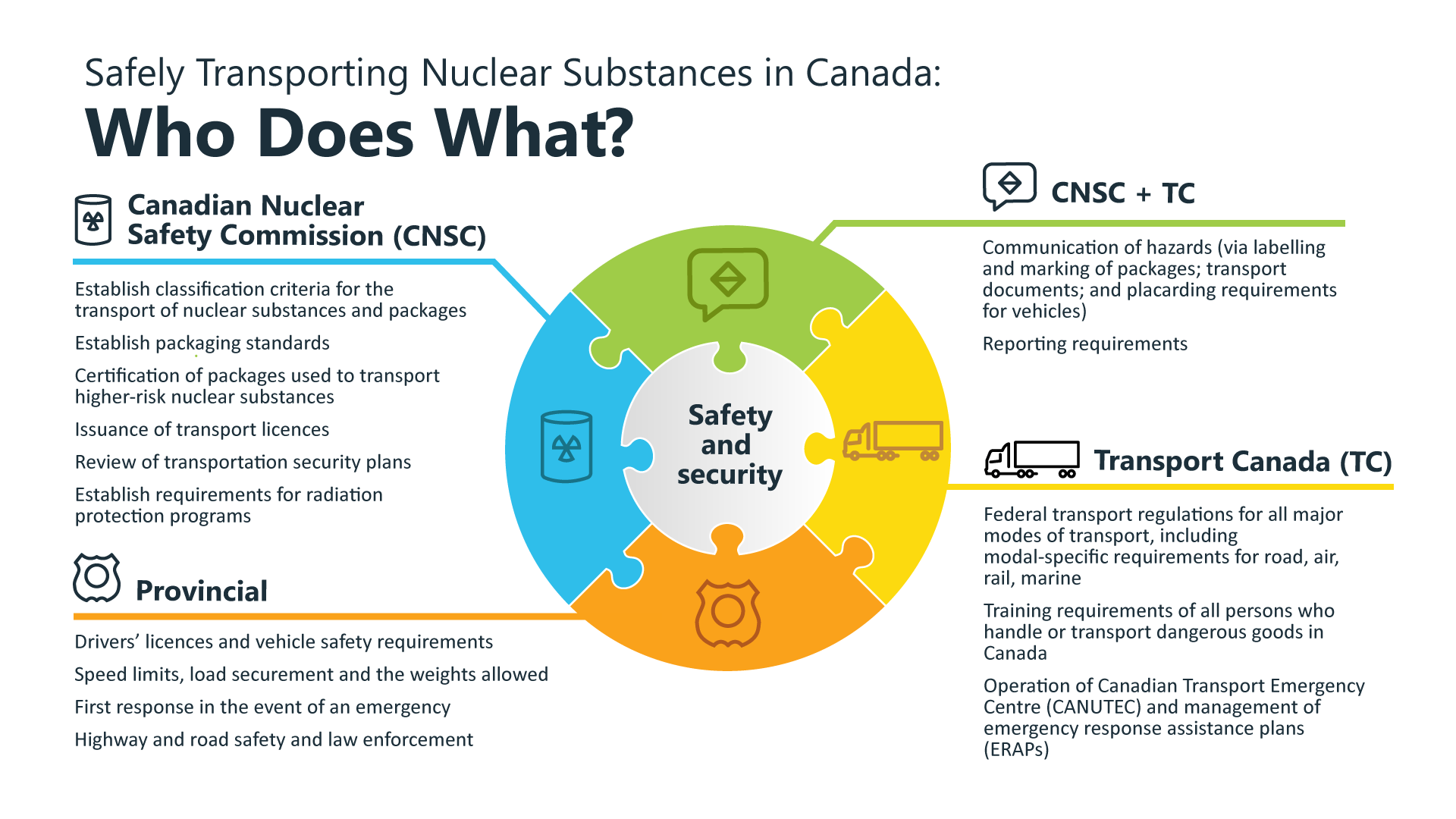
The CNSC and Transport Canada also work with provincial/territorial organizations to ensure shipments are completed safely.
Long description
Safely Transporting Nuclear Substances in Canada: Who Does What?
Canadian Nuclear Safety Commission (CNSC)
- Establish classification criteria for the transport of nuclear substances and packages
- Establish packaging standards
- Certification of packages used to transport higher-risk nuclear substances
- Issuance of transport licences
- Review of transportation security plans
- Establish requirements for radiation protection programs
Provincial
- Drivers’ licences and vehicle safety requirements
- Speed limits, load securement and the weights allowed
- First response in the event of an emergency
- Highway and road safety and law enforcement
Safety and security
CNSC and Transport Canada
- Communication of hazards (via labelling and marking of packages; transport documents; and placarding requirements for vehicles)
- Reporting requirements
Transport Canada
- Federal transport regulations for all major modes of transport, including modal-specific requirements for road, air, rail, marine
- Training requirements of all persons who handle or transport dangerous goods in Canada
- Operation of Canadian Transport Emergency Centre (CANUTEC) and management of emergency response assistance plans (ERAPs)
Licensing and certification
The CNSC also issues certificates and licences under the PTNSR 2015 for specific packages or shipments of nuclear substances.
Certification of transport packages and special form radioactive material
The CNSC regulates all aspects of the packaging and transport of nuclear substances. This includes the design, production, use, inspection, maintenance and repair of some packages.
The PTNSR 2015 requires that certain types of package design are certified by the CNSC before being used in Canada. It also includes provisions for the certification of special form radioactive material. These provisions specify that the sealed source must be strong enough to maintain leak tightness under the conditions of use and wear for which it was designed.
Learn more about the certification process for transport packages. See the list of CNSC certified transport packages and special form radioactive material.
Transport licences
The transport of nuclear substances is generally a regulated activity in Canada, with CNSC licensees involved in most shipments. The transport of nuclear substances does not require a CNSC transport-specific licence, except in the following circumstances:
- transport of Category I, II or III nuclear material
- transport of nuclear substances while in transit
- transport of nuclear substances contained in large objects
- transport of nuclear substances when the transport cannot meet all of the regulatory requirements
- transport of nuclear substances that require a multilateral approval of shipments
- transport of nuclear substances that require a special use vessel
Learn more about the transport licensing process.
Nuclear substances in transport
Regulated shipments of nuclear substances are required to have standardized marking and labelling. They must be accompanied by a shipping document that contains specific information. This ensures workers, members of the public and first responders can easily recognize the hazard associated with a regulated package.
Each person involved in packaging and transporting of regulated nuclear substances has a key safety role and must be trained accordingly, except in relation to excepted packages.
Consignors (senders) are responsible, among other duties, for:
- the proper classification and packaging of the nuclear substances
- the marking and labelling of the packages
- the preparation of the appropriate transport documents to accompany the shipments
Carriers are responsible for ensuring that:
- the packages have been properly loaded and secured on the means of transport
- safety marks remain properly displayed at all times
Consignees (receivers) are responsible for:
- verifying that the packages have not been damaged or tampered with during transport
- ensuring that the nuclear substances are properly unloaded from the packages
Carriers may include shipping lines, airlines and air cargo shippers, rail companies, couriers and trucking companies. Most are not CNSC licensees.
Each carrier of packages other than excepted packages must comply with the requirements of the PTNSR 2015. This includes the requirement to have a radiation protection program in place to ensure the protection and safety of workers, the general public and the environment due to transport activities.
Learn more about requirements for the radiation protection program for carriers.
Security in transport
A transport security plan must be submitted to the CNSC before any transport is approved in some cases. REGDOC-2.12.3, Security of Nuclear Substances: Sealed Sources and Category I, II and III Nuclear Material, offers assistance in preparing a written transportation security plan.
This plan includes a threat assessment and outlines measures such as:
- escort personnel
- communication arrangements
- security searches prior to shipment
- contingency plans in case of a mechanical breakdown of the vehicle
- protocols to be followed during scheduled stops or unscheduled delays
Transport security plans and routes are classified as prescribed information and cannot be shared with the public.
Transport accidents
Consignors (senders), carriers and consignees (receivers) of packages other than excepted packages have specific requirements under the PTNSR 2015 and the TDG Regulations. They must have measures in place to respond to unusual situations involving the transport of their nuclear substances.
The TDG Regulations also require the consignor to include a 24-hour telephone number on the transport document that accompanies packages containing nuclear substances. The purpose of this requirement is to ensure that appropriate technical assistance is immediately available to emergency responders. This requirement does not apply to excepted packages.
The PTNSR 2015 requires that all accidents and dangerous occurrences are reported to the CNSC immediately. CNSC staff can follow up to provide appropriate technical information and advice to responders onsite once they are notified of a transport accident involving nuclear substances. CNSC staff can also ensure that adequate actions are taken to lessen the consequences of the event. They can be deployed immediately, if needed, to provide guidance on managing the incident.
The consignor’s emergency response plan or transport plan contains the procedures to follow in the event of an accident. The plan details:
- the response actions to be taken
- the resources available to mitigate the situation
- how to return the accident area to normal conditions
Outreach and engagement
Licensees and applicants have a responsibility to inform communities about their ongoing or proposed projects and activities. The CNSC also has a role to play in outreach and engagement related to licensed facilities and activities. In fact, the CNSC mission includes the following responsibilities:
- disseminating objective scientific, technical and regulatory information
- strengthening confidence through open communication and engagement to build and foster trusted relationships with Indigenous Nations and other communities in Canada and globally
The CNSC has engaged, and will continue to engage upon request, with interested Indigenous Nations and the public to meet and discuss the CNSC’s regulatory requirements and oversight of the transport of nuclear substances.
Related links
Packaging and transportation of nuclear substances
Protecting people and the environment
Contact us
Contact the CNSC for any questions related to the packaging and transport of nuclear substances in Canada.
Page details
- Date modified: