
Readiness to regulate small modular reactors
CNSC Website User Survey
Share your experience in using our website by completing our survey. The survey should take you less than 10 minutes to complete.
Small modular reactors (SMRs) are a new class of nuclear reactors. They are much smaller in size and power output than traditional nuclear power reactors and have enhanced safety features.
Novel reactor technologies, including SMRs, may potentially supply power to smaller electrical grids or to remote, off-grid areas. They may also be used for other purposes, including supplying heat for industrial applications.
About SMRs
What is a small modular reactor?
Transcript
What is a small modular reactor?
Small modular reactors, or SMRs, use fission to create heat that generates energy like traditional nuclear reactors.
They’re designed to be smaller than a traditional reactor.
They vary in size and the power they produce.
What about regulation?
The CNSC has been providing feedback to companies for several years through the pre-licensing vendor design review process.
Big or small and no matter the technology, the CNSC’s role is to regulate the nuclear industry and protect the health and safety of the public and the environment.
Canadian Nuclear Safety Commission
Government of Canada
How small are small modular reactors?
Transcript
How small are small modular reactors?
They can be as small as a three-storey building or as large as an entire city block.
That’s the equivalent of a mid-size shopping mall!
Regardless of their size, the major parts of SMRs will be housed within a larger facility.
This is where you will find systems that... support safe operation and maintenance, harness heat, which can do useful things like generate electricity.
We have been preparing to regulate SMR projects for many years.
Anyone who wants to build and operate an SMR facility needs to meet our requirements for... Safety, security, environmental protection, Canada’s commitments to nuclear non-proliferation.
Big or small and no matter the technology, it’s the CNSC’s role to regulate the nuclear industry and protect the health and safety of the public and the environment.
Canadian Nuclear Safety Commission
Government of Canada
How are small modular reactors regulated in Canada?
Transcript
Music: Soft, upbeat music begins.
How are small modular reactors regulated in Canada?
Small modular reactors – or SMRs – are regulated the same way as other nuclear facilities. At the CNSC, we are responsible for this important work.
We regulate the development, production and use of nuclear energy in Canada by:
- setting rigorous safety and security requirements to make sure people and the environment are protected
- consulting with Indigenous Nations and communities
- engaging with the public
- ensuring these high standards are maintained throughout the lifecycle of each facility
The independent Commission makes transparent licensing decisions through a public hearing process, based on input received as part of the hearing.
Everyone is welcome and encouraged to participate in this process.
You can:
- observe online
- attend a public proceeding
- submit an intervention
Funding is available to support informed and topic-specific interventions for public hearings.
The CNSC, along with its federal partners, will always ensure that all SMRs are regulated to be safe.
Music: The music fades out.
How much power an SMR can generate
SMRs may be used on small grids where power generation needs are usually less than 300 megawatt electric (MWe) for each facility. To help you understand this scale, 300 MWe of electricity can power approximately 300,000 homes.
SMRs can also be at edge-of-grid or off-grid locations where power needs are small – in the range of 2 to 30 MWe. They may be used for electrifying smaller communities or for industrial applications.
Types of SMR technologies
SMRs can vary significantly in size, design features and cooling types. Examples of SMR technologies include:
- integral pressurized-water reactors
- molten salt reactors
- high-temperature gas reactors
- liquid metal-cooled reactors
- solid state or heat pipe reactors
Electrical utilities, industry groups and government agencies throughout the world are looking at alternative uses for SMRs beyond electricity generation.
These uses include:
- producing steam for industrial applications or district heating systems
- making products such as hydrogen fuel and desalinated drinking water
The Canadian Nuclear Safety Commission (CNSC) regulates activities associated with all of these applications. Learn more about new reactor facility projects in Canada.
Regulating and licensing SMRs
The CNSC’s regulatory framework can include a structured approach, which staff use to assess applications for SMRs, including:
- the pre-licensing vendor design review (VDR) process
- international agreements
The CNSC is also responsible for regulatory oversight of the management of radioactive waste. This includes the handling, processing, transport, storage and disposal of the waste. Waste management is essential to the safety case of an SMR project.
Public engagement and Indigenous engagement are essential elements of the regulatory process. They are important considerations in the independent Commission’s decision-making process for a licence. These groups are encouraged to participate:
- Indigenous Nations and communities
- members of the public
- SMR proponents
- stakeholders
Funding programs are available to support engagement and participation.
Meet some of the CNSC experts who support and contribute to Canada’s SMR readiness.
SMR Readiness project
The CNSC has created the SMR Readiness project to increase its ability to license and regulate SMRs. The project will help the CNSC to be seen as an international leader in SMR regulation.
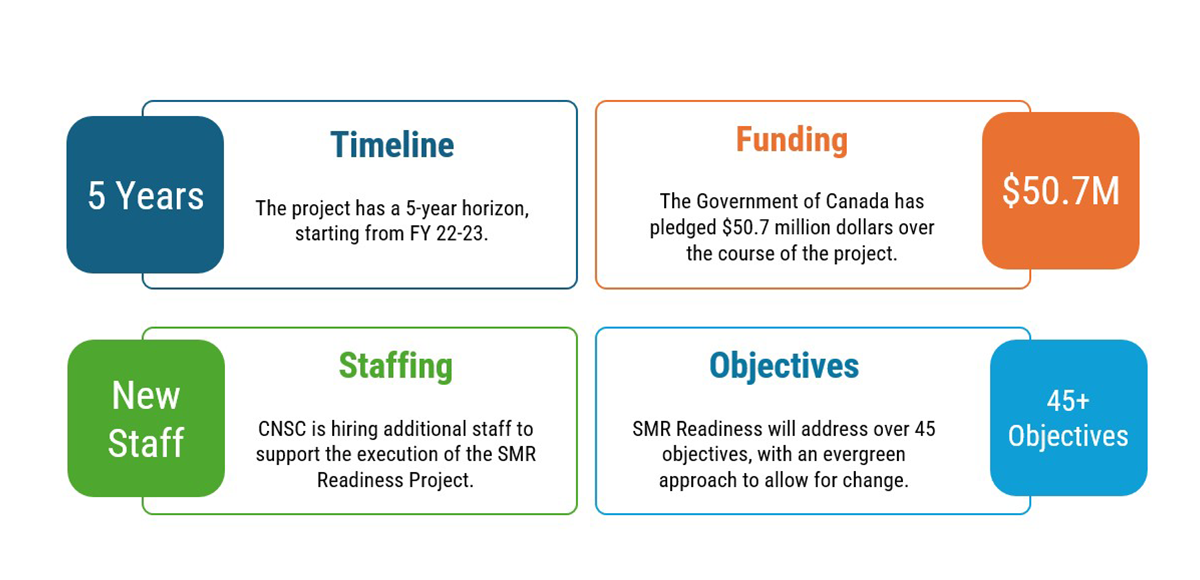
The project is based on a 5-year project horizon with $50.7 million in funding. This will enable the CNSC to make a significant investment in its staff to address over 45 SMR Readiness objectives.
SMR Readiness project pillars
The project is based on optimizing these 4 pillars.
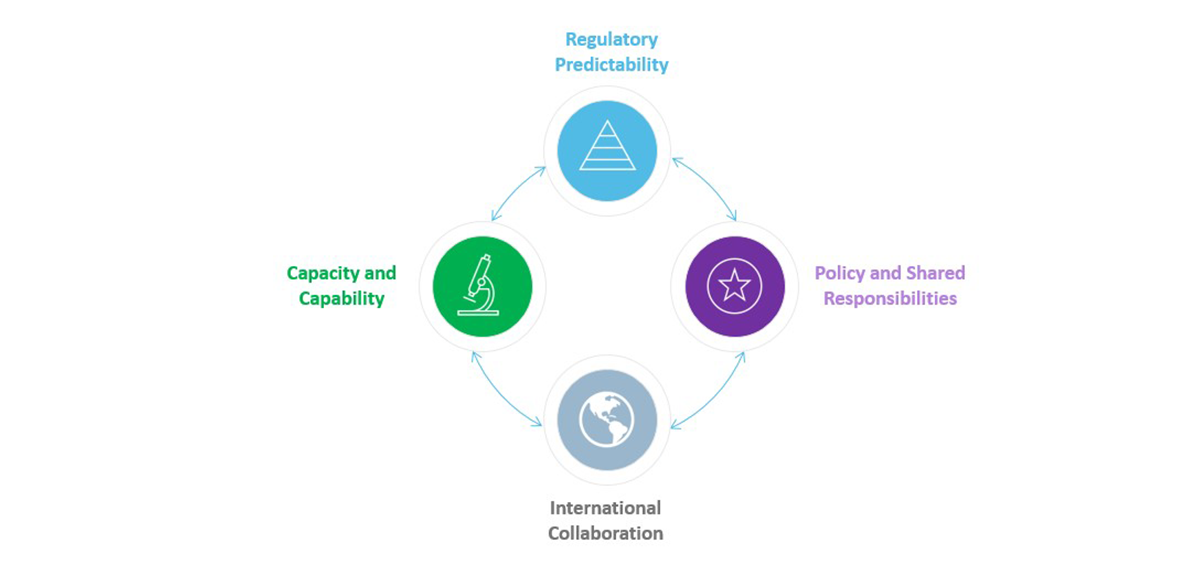
A description of each pillar follows.
Regulatory predictability and clarity
The Regulatory Predictability pillar focuses on optimizing the CNSC’s regulatory framework for SMR licensing and providing regulatory clarity to SMR proponents. This will be reflected through the assessment and revision of regulatory documents to ensure technological inclusivity.
Read the Regulatory predictability and clarity section on the Small Modular Reactor Readiness – 4 pillars page to learn more about each element under this pillar. The information includes the title, description, outcome(s) and status of each element.
Building capacity and capability
The Capacity and Capability pillar is aimed at improving and expanding the CNSC’s technical ability and competency in SMRs. This especially applies to SMRs geared towards non-water-cooled designs. SMRs use:
- a variety of new reactor designs
- emerging/disruptive technologies not employed at today’s nuclear power plants
- innovative construction approaches
The CNSC must be ready to regulate SMRs effectively and efficiently without compromising safety. This requires independent research, internal expertise and documented regulatory positions in these areas to support licensing reviews.
Read the Capacity and Capability section on the Small Modular Reactor Readiness – 4 pillars page to learn more about each element under this pillar. The information includes the title, description, outcome(s) and status of each element.
Supporting policy and coordinating shared responsibility
Several policies are being reviewed to ensure that they are responsive to the potential deployment of SMRs in Canada. These policies are owned by federal, provincial and in some cases, territorial governments.
The Policy and Shared Responsibilities pillar enables the CNSC to provide technical advice in the development or review of these policy instruments. Work done under this pillar will also focus on establishing or modifying memoranda of understanding, or other collaborative tools to find efficiencies.
Read the Supporting policy and coordinating shared responsibility section on the Small Modular Reactor Readiness – 4 pillars page to learn more about each element under this pillar. The information includes the title, description, outcome(s) and status of each element.
International collaboration
The International Collaboration pillar aims to strengthen existing international collaboration efforts and more strongly pursue international harmonization goals. The CNSC recognizes the mutual benefits that can be realized through leveraging the breadth and depth of the experience and expertise of other regulators. This pillar explores ways to achieve and optimize international regulatory harmonization.
Read the International collaboration section on the Small Modular Reactor Readiness – 4 pillars page to learn more about each element under this pillar. The information includes the title, description, outcome(s) and status of each element.
Contact us
For general questions about the SMR Readiness project, you can contact us:
-
Telephone: 1-888-229-2672
(toll-free in Canada and the U.S.) - Fax: 613-995-5086
- Email: smr-prm@cnsc-ccsn.gc.ca
Page details
- Date modified: