
National Sealed Source Registry and Sealed Source Tracking System Report for 2025
Introduction
Sealed sources are radioactive nuclear substances encased in a sealed capsule or in a cover to which the substance is bonded. A source’s capsule or cover is strong enough to prevent contact with, or dispersion of, the substance under the conditions for which the capsule or cover is designed. Sealed sources can be used for a variety of activities, including medical, industrial, commercial, and academic and research applications. An inventory of sealed sources within Canada is housed in the National Sealed Source Registry (NSSR), which was established in 2006 to conform to the International Atomic Energy Agency (IAEA) Code of Conduct on the Safety and Security of Radioactive Sources. The NSSR is used to maintain an accurate and secure inventory of sealed sources in Canada, with a particular focus on those classified as high risk.
The Sealed Source Tracking System (SSTS) is a secure information-management system used in conjunction with the NSSR to track new and existing high-risk sources within Canada. Source transfers done online through the SSTS update and populate the NSSR so that the information is as current as the licence reporting allows. The timelines to report the receipt of a source (following either a domestic transfer or an import) is within 2 days of receipt. An export must be reported 7 days in advance of the export. A domestic transfer must be reported 24 hours prior to the transfer. The CNSC places particular emphasis on capturing data on high-risk sources, with the NSSR housing detailed information such as the source serial number, isotope, activity, and current location. Information on moderate- and low-risk sources is updated annually using the inventory data included in licensees’ annual compliance reports (ACRs) and validated by the CNSC for accuracy and consistency.
Categories of sealed sources
Sealed sources are classified by the IAEA into five different categories:
- Category 1: Very high risk (personally extremely dangerous)
- Category 2: High risk (personally very dangerous)
- Category 3: Moderate risk (personally dangerous)
- Category 4: Low risk (unlikely to be personally dangerous)
- Category 5: Very low risk (most unlikely to be personally dangerous)
For more information on how sealed sources are categorized, consult the CNSC website.
Summary of Sealed Source Inventory
By the end of 2025, the NSSR contained information on 202,838 radioactive sealed sources in Canada. The SSTS actively tracks Category 1 and 2 sources. In 2025, 5,863 Category 1 and 89,376 Category 2 sources were tracked. The remaining 107,599 sealed sources in the NSSR were Category 3, 4 or 5, which are not subject to mandatory tracking for every movement. Figure 1 shows the total number of sealed sources, as well as the number of sealed sources in each category, that were accounted for in Canada on December 31, 2025.
Figure 1. Breakdown of sealed sources in Canada on December 31, 2025
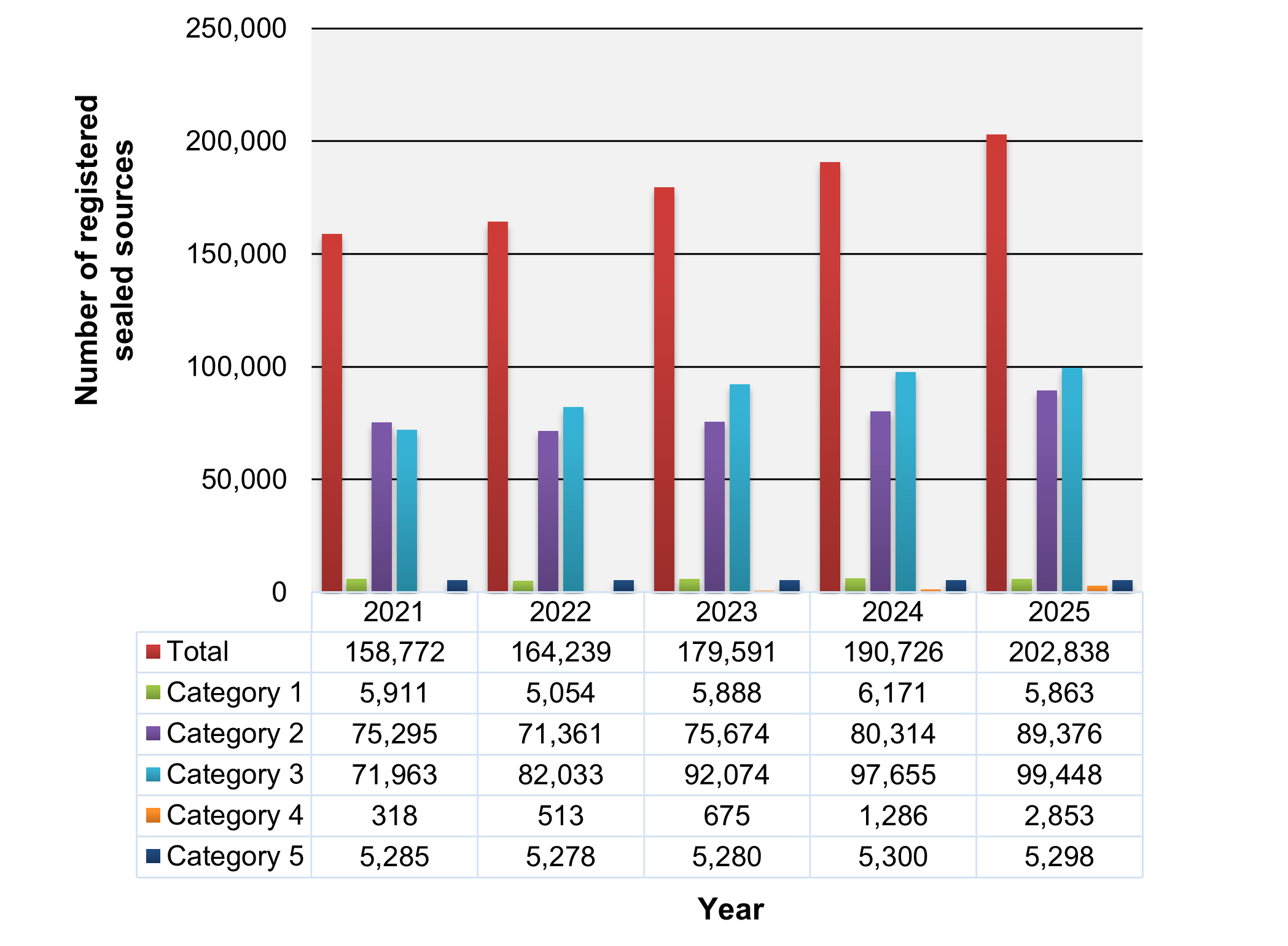
Figure 1: Text desciption
A graph and table show the total number of sealed sources, as well as the number of sealed sources in each category, that were accounted for in the National Sealed Source Registry from 2021 to 2025.
There were 158,772 total sealed sources accounted for in the National Sealed Source Registry in 2021: 5,911 Category 1 sealed sources, 75,295 Category 2 sealed sources, 71,963 Category 3 sealed sources, 318 Category 4 sealed sources, and 5,285 Category 5 sealed sources.
There were 164,239 total sealed sources accounted for in the National Sealed Source Registry in 2022: 5,054 Category 1 sealed sources, 71,361 Category 2 sealed sources, 82,033 Category 3 sealed sources, 513 Category 4 sealed sources, and 5,278 Category 5 sealed sources.
There were 179,591 total sealed sources accounted for in the National Sealed Source Registry in 2023: 5,888 Category 1 sealed sources, 75,674 Category 2 sealed sources, 92,074 Category 3 sealed sources, 675 Category 4 sealed sources, and 5,280 Category 5 sealed sources.
There were 190,726 total sealed sources accounted for in the National Sealed Source Registry in 2024: 6,171 Category 1 sealed sources, 80,314 Category 2 sealed sources, 97,655 Category 3 sealed sources, 1,286 Category 4 sealed sources, and 5,300 Category 5 sealed sources.
There were 202,838 total sealed sources accounted for in the National Sealed Source Registry in 2025: 5,863 Category 1 sealed sources, 89,376 Category 2 sealed sources, 99,448 Category 3 sealed sources, 2,853 Category 4 sealed sources, and 5,298 Category 5 sealed sources.
Performance measures and verification
To gauge the effectiveness of the SSTS and verify the accuracy of the data in the system, CNSC inspectors physically cross-reference SSTS data against licensees’ actual inventory of sealed sources. Routine CNSC compliance inspections include the verification of sealed source tracking information. Inconsistencies are immediately addressed to ensure accuracy in the data.
In 2025, CNSC inspectors verified licensees’ compliance with sealed source tracking requirements during 72 inspections. Of these, licensees were compliant in 92% of cases (66 inspections). Four of the non-compliances were related to a reporting period issue, one non-compliance was related to improper tracking of source movements, and one non-compliance involved incomplete receipt and transfer records, which prevented full verification of compliance with licence requirements. In all six cases, the licensees adequately addressed the issues.
For more information on inspection results of Canadian licensees using nuclear substances relative to doses to workers, radiation protection, operating performance and sealed source security, refer to the annual Regulatory Oversight Report on the Use of Nuclear Substances in Canada.
Event mitigation
Licensees must immediately report lost or stolen nuclear substances to the CNSC and must also submit descriptions of any actions taken or proposed to recover missing nuclear substances. The CNSC investigates every such event and informs local, national, and international stakeholders who may assist with recovery. A list of events involving sealed sources can be found in the Lost, Stolen and Found Sealed Sources and Radiation Devices Report.
A total of 8 sealed sources were involved in 6 events in 2025. Four Category 4 sources contained in 2 portable gauges were stolen but were not recovered and four Category 5 sources were lost and not recovered.
The International Nuclear and Radiation Events Scale (INES) is a tool for communicating the safety significance of nuclear and radiological events to technical communities and the public. Every event reported from the commercial, academic and research, industrial, and medical sectors is classified in accordance with the INES, based on its safety significance rating. An event classified as level 0 (or “below scale”) has no safety significance, level 1 is an anomaly, level 2 is an incident, level 3 is a serious incident, level 4 is an accident with local consequences, level 5 is an accident with wider consequences, level 6 is a serious accident, and level 7 is a major accident. The levels, excluding level 0, are broken into 2 sections; levels 1, 2, and 3 are incidents while levels 4 through 7 are accidents. Two events involving lost, stolen, or found sources in 2025 were rated as INES Level 1. Four events were rated as Level 0, which are considered below scale and have no safety significance.
Figures 2 and 3 present data on lost and stolen sources in Canada from 2021 to 2025.
Figure 2. Number of reported events involving lost, stolen and found sealed sources from 2021 to 2025
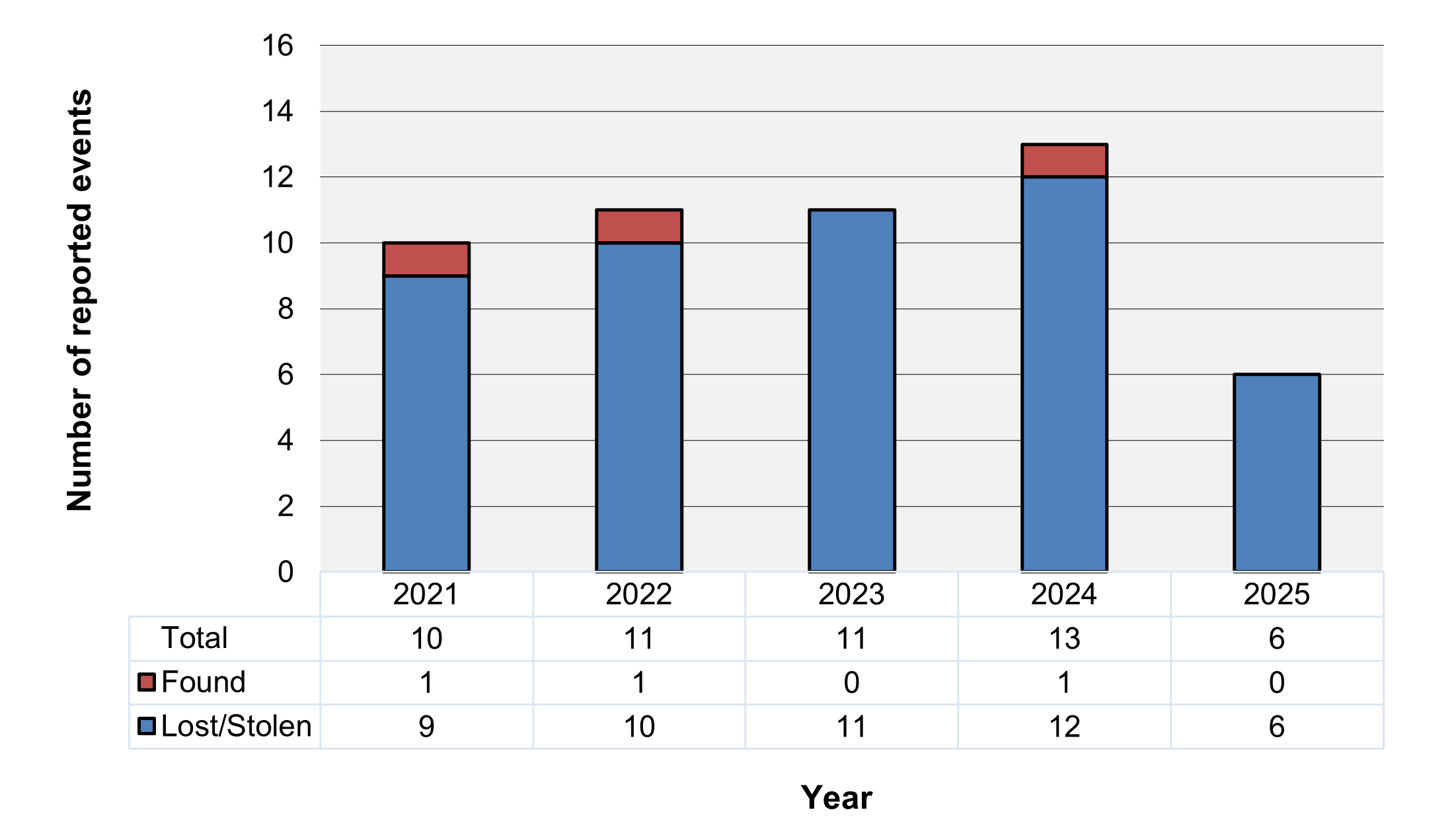
Figure 2: Text description
A graph and table show the total number of events involving found, lost, and stolen sealed sources, the number of events involving found sealed sources, and the number of events involving lost or stolen sealed sources, that were reported from 2021 to 2025.
There were 10 events reported in 2021: 1 involving found sealed sources and 9 involving lost or stolen sealed sources.
There were 11 events reported in 2022: 1 involving found sealed sources and 10 involving lost or stolen sealed sources.
There were 11 events reported in 2023: none involving found sealed sources and 11 involving lost or stolen sealed sources.
There were 13 events reported in 2024: 1 involving found sealed sources and 12 involving lost or stolen sealed sources.
There were 6 events reported in 2025: none involving found sealed sources and 6 involving lost or stolen sealed sources.
Figure 3: Number of lost, stolen and recovered sealed sources from 2021 to 2025
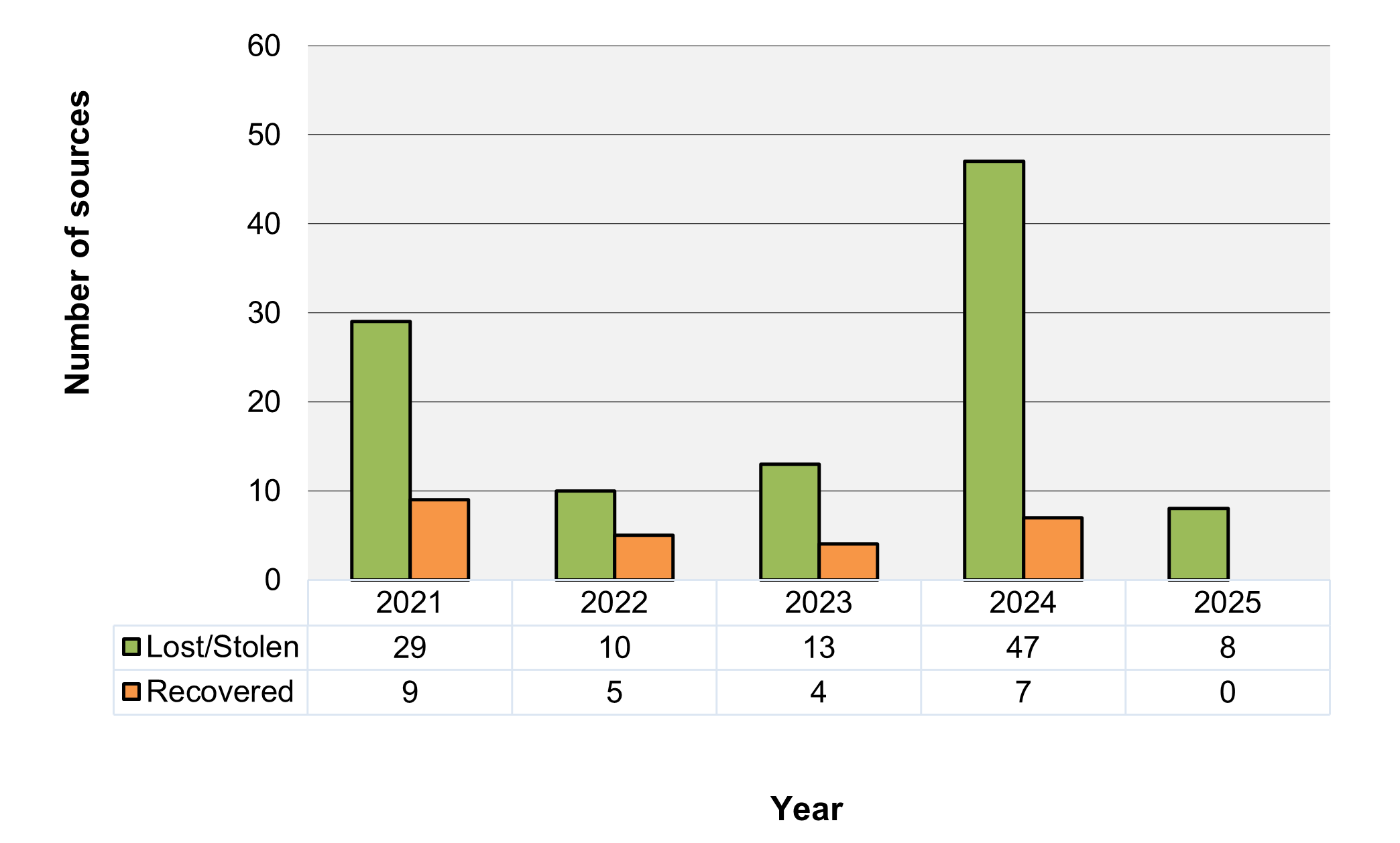
Figure 3: Text description
A graph and table show the number of lost or stolen sealed sources and the number of found or recovered sealed sources that were reported from 2021 to 2025.
There were 29 lost or stolen sealed sources and 9 found or recovered sealed sources reported in 2021.
There were 10 lost or stolen sealed sources and 5 found or recovered sealed sources reported in 2022.
There were 13 lost or stolen sealed sources and 4 found or recovered sealed sources reported in 2023.
There were 47 lost or stolen sealed sources and 7 found or recovered sealed sources reported in 2024.
There were 8 lost or stolen sealed sources and no sealed sources were reported as found or recovered in 2025.
Transaction statistics
The NSSR is populated by licensees reporting their transactions via the online SSTS interface or by other means such as fax or email. Figures 4, 5, and 6 show transactions entered in the SSTS in 2025, statistics for import and export of sealed sources, and the percentage of online SSTS transactions from 2021 to 2025, respectively. The CNSC publishes SSTS transaction data as part of the Government of Canada’s Open Data initiative.
Figure 4. SSTS transactions in 2025
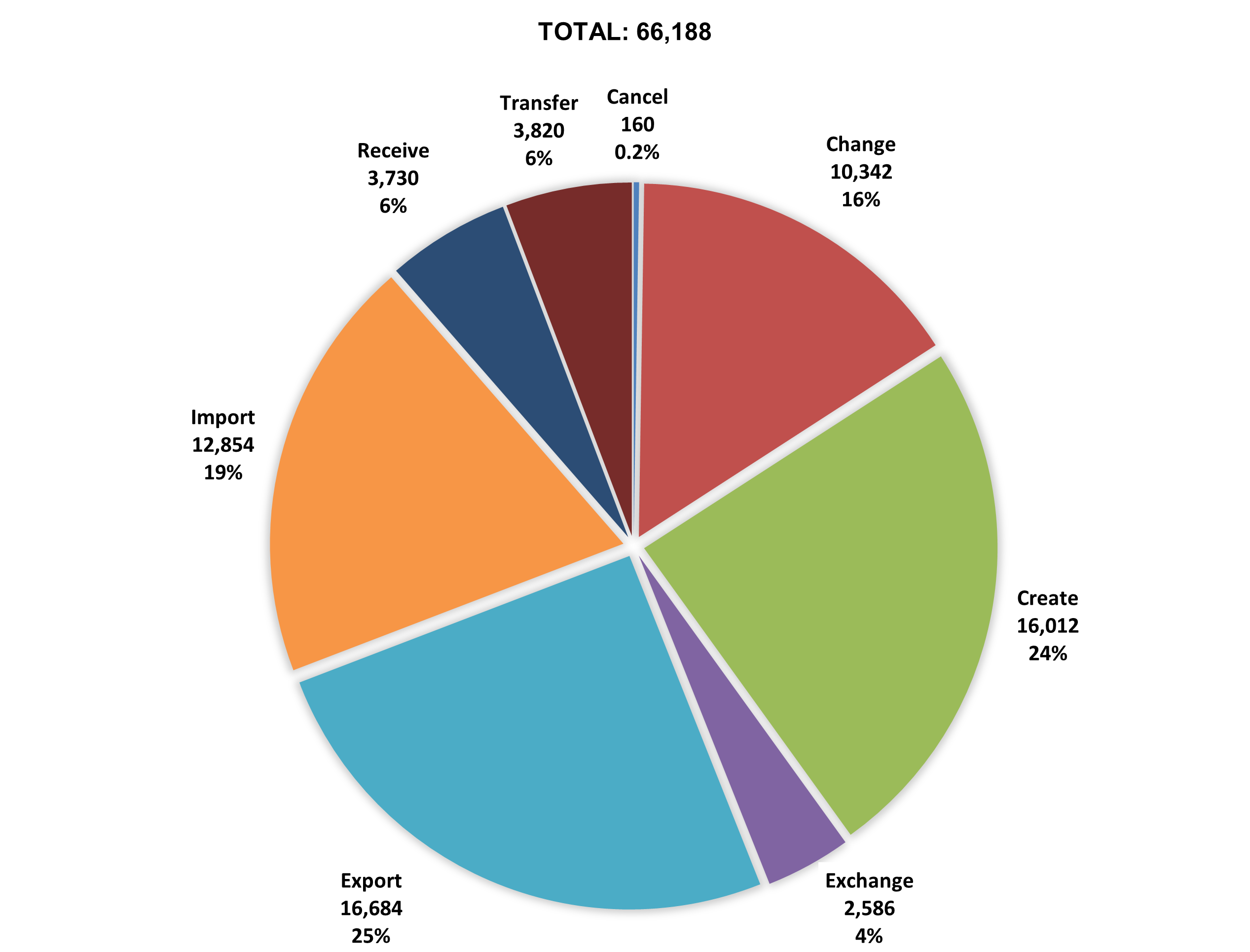
Figure 4: Text description
A chart shows total number and the number of each type of SSTS transaction in 2025. Of the total 66,188 SSTS transactions in 2025, 160 or 0.2% were Cancel, 10,342 or 16% were Change, 16,012 or 24% were Create, 2,586 or 4% were Exchange, 16,684 or 25% were Export, 12,854 or 19% were Import, 3,730 or 6% were Receive, and 3,820 or 6% were Transfer.
| Create | Exchange | Export | Import |
|---|---|---|---|
|
|
|
|
| Receive | Transfer | Change | Cancel |
|
|
|
|
Users of nuclear substances in Canada routinely import and export sealed sources in accordance with their licences.
Figure 5. Number of sealed source imports and exports from 2021 to 2025
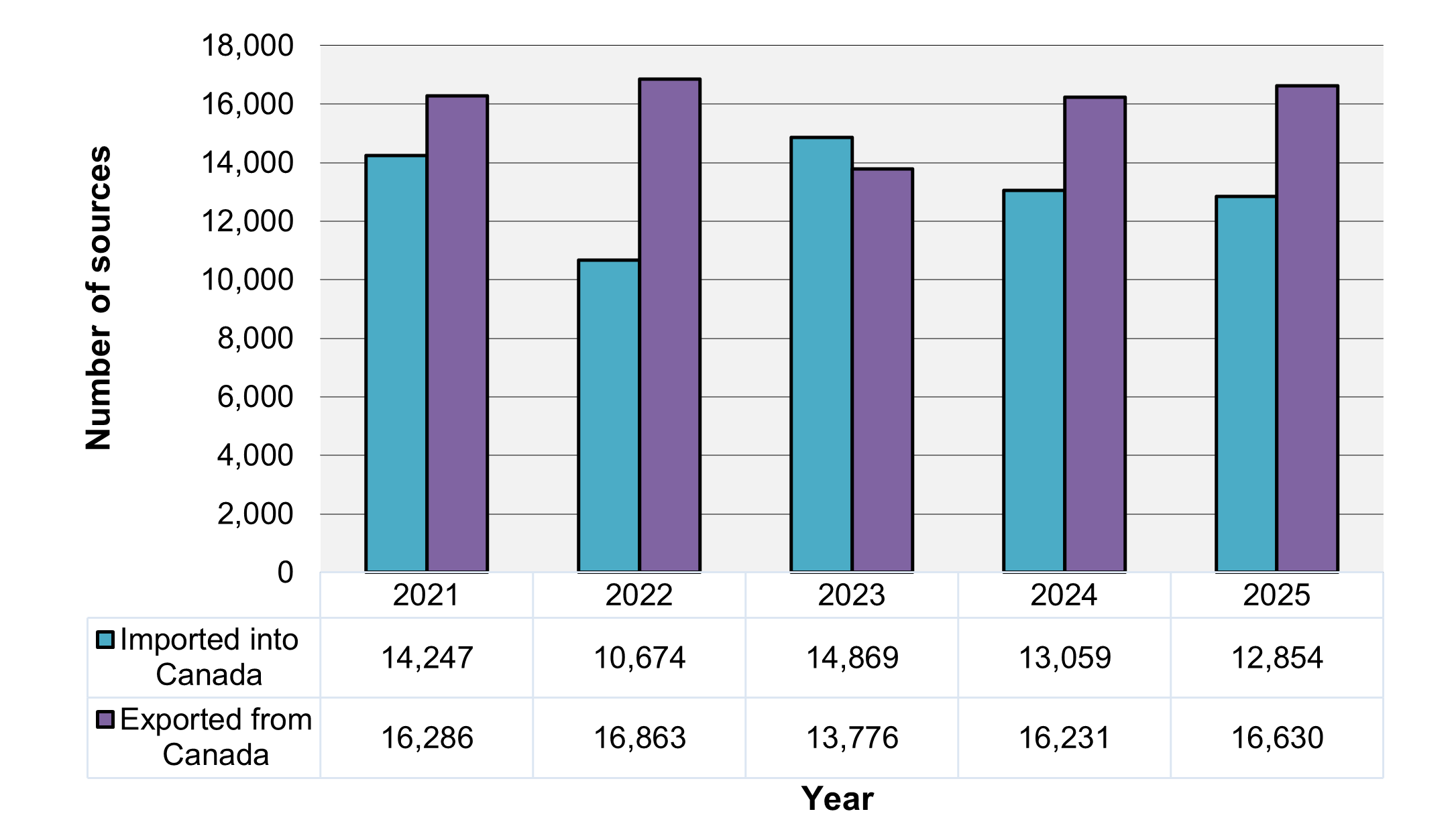
Figure 5: Text description
A graph and table show the number of sealed sources imported into Canada and exported from Canada from 2021 to 2025.
There were 14,247 sealed sources imported and 16,286 sealed sources exported in 2021.
There were 10,674 sealed sources imported and 16,863 sealed sources exported in 2022.
There were 14,869 sealed sources imported and 13,776 sealed sources exported in 2023.
There were 13,059 sealed sources imported and 16,231 sealed sources exported in 2024.
There were 12,854 sealed sources imported and 16,630 sealed sources exported in 2025.
Licensees report transactions online (through the SSTS Web portal) or via email or fax to the CNSC. Transactions reported to the CNSC via email or fax are entered into the system by CNSC staff on behalf of the licensee.
Figure 6. Percentage of SSTS transactions completed online from 2021 to 2025
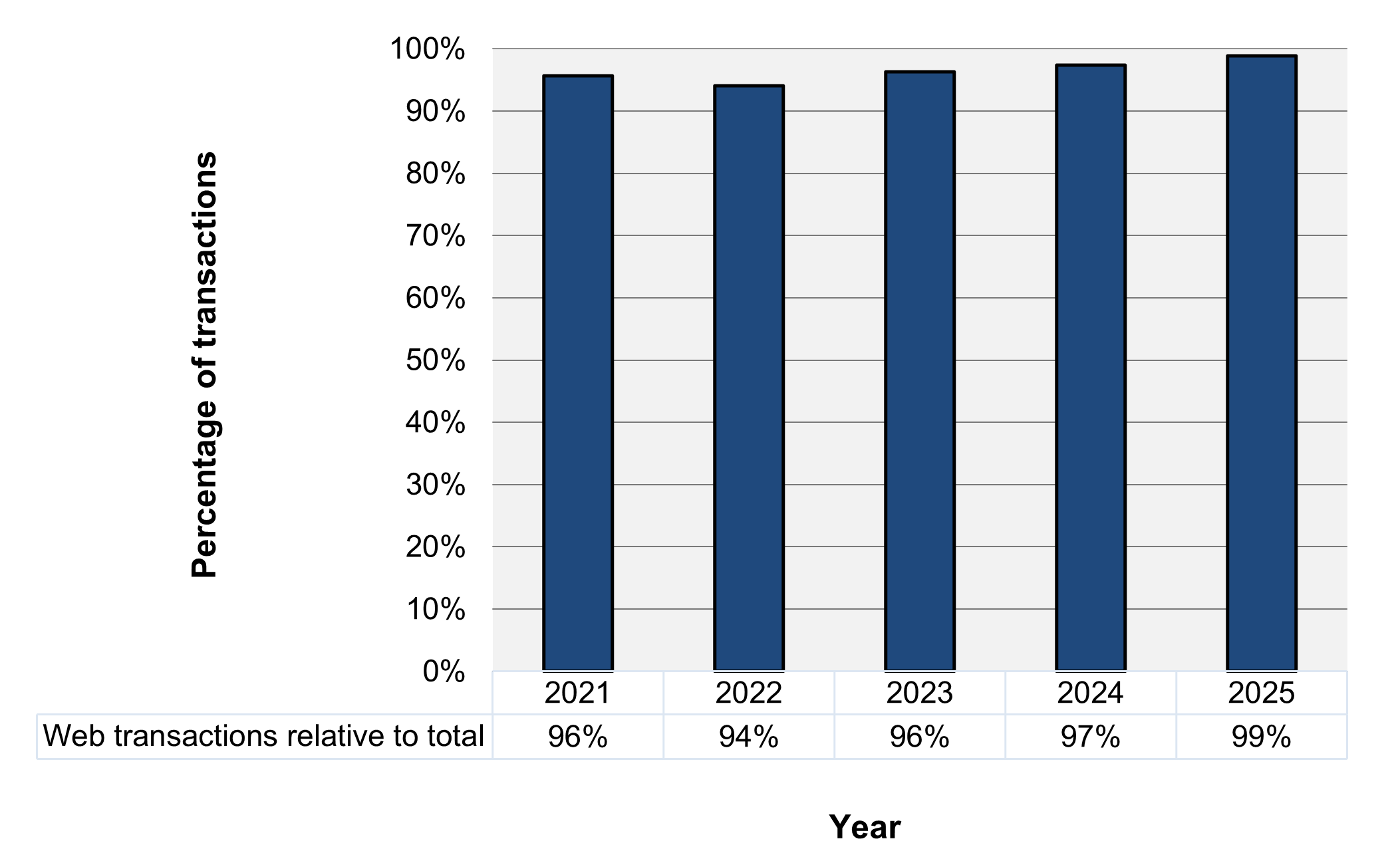
Figure 6: Text description
A graph and table show the percentage of SSTS web transactions relative to total SSTS transactions from 2021 to 2025.
96% of SSTS transactions were performed online in 2021.
94% of SSTS transactions were performed online in 2022.
96% of SSTS transactions were performed online in 2023.
97% of SSTS transactions were performed online in 2024.
99% of SSTS transactions were performed online in 2025.
Conclusion
The licensees’ continued use of the SSTS indicate that its implementation, as well as that of the NSSR, has been effective, and that Canada is maintaining its commitment to the Code of Conduct on the Safety and Security of Radioactive Sources.
Additional resources
Page details
- Date modified: