
Independent Environmental Monitoring Program: Pickering nuclear site
| Site name | Pickering nuclear site |
|---|---|
| Licensee | Ontario Power Generation (OPG) |
| Facility names | Pickering Nuclear Generating Station and Pickering Waste Management Facility |
| Facility location | North shore of Lake Ontario, Pickering, Ontario |
| Land acknowledgement | The CNSC acknowledges that the Pickering nuclear site is located within the traditional lands and waters of the Michi Saagiig Anishinaabeg, the Gunshot Treaty (1787–88), the Williams Treaties (1923), and the Williams Treaties Settlement Agreement (2018). |
| Facility description | OPG operates 4 reactor units on the Pickering nuclear site. There are also 2 reactors in safe storage, 2 shut-down reactors, and a waste management facility on the site. |
| Environmental protection requirements | In accordance with regulatory requirements under the Nuclear Safety and Control Act, all licensees of Class I nuclear facilities and uranium mines and mills must maintain a comprehensive environmental protection program to monitor and control nuclear and hazardous substances released from the facilities they own and operate. As part of every licensee’s environmental protection program, concentrations of contaminants in the environment must be determined and the potential exposure pathways to the public must be assessed and mitigated. |
Our IEMP results from 2025, 2021, 2017, 2015 and 2014 are consistent with the results submitted by OPG, supporting our assessment that the licensee’s environmental protection program is effective. The results add to the body of evidence that people and the environment in the vicinity of the Pickering nuclear site are protected and that there are no anticipated health impacts from the operation of the facilities on the site.
- Interactive map and IEMP results
- Data table (Download CSV – 73 KB)
- Results: (2025) (2021) (2017) (2015) (2014)
- Related links
Legend
Pickering nuclear site
2025 results
The 2025 IEMP sampling plan for the Pickering nuclear site focused on radioactive nuclear and hazardous substances. A site-specific sampling plan was developed based on the licensee’s approved environmental monitoring program and our regulatory experience with the site. We endeavour to incorporate traditional Indigenous land use, values and knowledge by engaging with Indigenous Nations and communities on the sampling plan. More information on this engagement is provided in the “Indigenous Nations and communities’ participation” section.
In May 2025, we collected air, water, soil, sediment, sand, and vegetation samples in publicly accessible areas outside the facility perimeter.
The levels of radioactivity measured in the samples were below available guidelines and our own screening levels. Our screening levels are based on conservative assumptions about the exposure that would result in a dose of 0.1 millisieverts (mSv) per year (one-tenth of the regulatory public dose limit of 1 mSv/year). Measurements conducted by the IEMP to date have consistently found levels of radioactivity in the environment to be low, and well within the range of natural background radiation levels. As a result, no effects on human health are expected.
In one lake-water sample in 2025, the most restrictive guideline for aluminum was exceeded. The guideline was established for the protection of aquatic life given long-term (chronic) exposures. Previous results at this sampling location, and the 2025 data at other nearby sampling locations, indicate that chronic exposure of aquatic receptors and potential adverse effects are unlikely. This elevated level of aluminum was well below another applicable guideline, that of the maximum acceptable concentration for drinking water. Therefore, no adverse effects on human health are expected. Recently, CNSC staff reviewed the 2025 Predictive Environmental Risk Assessment for Pickering Refurbishment, Decommissioning and Continued Operations, which demonstrated that elevated concentrations of aluminum and other metals measured in water cannot be exclusively attributed to the OPG facility. CNSC staff will continue to monitor and assess long-term concentrations of aluminum in water near the Pickering site to confirm that people and the environment are protected.
2021 results
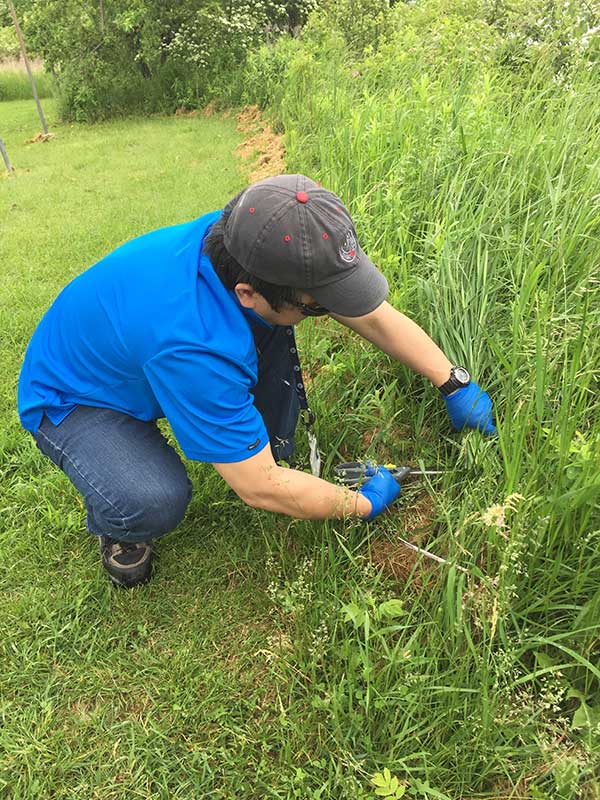
CNSC staff taking vegetation samples near the Pickering nuclear site in 2017.

CNSC staff taking water samples at a public beach near the Pickering nuclear site in 2017.
The 2021 IEMP sampling plan for the Pickering Nuclear Generating Site focused on radiological and non-radiological substances. A site-specific sampling plan was developed based on the licensee’s approved environmental monitoring program and our regulatory experience with the site. We endeavour to incorporate traditional Indigenous land use, values and knowledge by engaging with Indigenous Nations and communities on the sampling plan. More information on this engagement is provided in the “Indigenous Nations and Communities’ Participation” section.
In July 2021, we collected air, water, soil, sand and vegetation samples in publicly accessible areas outside the facility perimeter.
The levels of radioactivity and hazardous substances measured in air, water, soil, sand and vegetation were below available guidelines and our own screening levels. Our screening levels are based on conservative assumptions about the exposure that would result in a dose of 0.1 mSv per year (1/10 of the regulatory public dose limit of 1 mSv per year). Measurements conducted through the IEMP to date have consistently found levels of radioactivity in the environment to be low, and well within the range of natural background radiation levels. As a result, no effects on human health are expected.
2014, 2015, and 2017 Results
The 2017 IEMP sampling plan for the Pickering site focused on nuclear and hazardous contaminants. A site-specific sampling plan was developed based on OPG's approved environmental monitoring program and the CNSC's regulatory experience with the site. In 2017, samples were collected in publicly accessible areas outside the Pickering site perimeter and included air, lake water, soil, sediment and sand, grass and wild vegetation, and food such as milk, fruit and vegetables from a local farm near the Pickering site. View detailed sampling data.
The measured radioactivity levels in all the samples with detectable radionuclide concentrations were below CNSC reference levels. These reference levels are based on conservative assumptions about the exposure that would result in a dose of 0.1 mSv/year, which represents one-tenth of the CNSC's public dose limit of 1 mSv/year. Overall, the results indicate that no health impacts are expected at this dose level.
Indigenous Nations and communities’ participation
We have made it a priority to ensure that IEMP sampling reflects Indigenous knowledge, land use and values where possible. In addition to conducting routine IEMP sampling activities, we seek input from local Indigenous Nations and communities on IEMP sampling plans. In advance of the 2025 IEMP sampling campaign around the Pickering site, CNSC staff notified Indigenous Nations and communities near the facilities of the planned sampling campaign, sought their input on the sampling plan, and invited them to join CNSC staff in the field for sampling activities.
Curve Lake First Nation
Curve Lake First Nation (CLFN) reviewed the sampling plan in April 2025 and provided comments about species and locations of interest for sampling. CLFN joined the CNSC field team to assist in the collection of sand, water, soil and vegetation samples. CNSC staff explained the program and the chain of custody procedures for the collected samples to CLFN. CNSC staff also walked CLFN through the air sampling process and equipment. CLFN actively participated in the sampling. Additionally, CLFN identified and sampled willow, healall, cedar and sumac with the CNSC team. The CNSC is committed to working with CLFN to ensure that the IEMP reflects their Indigenous knowledge, land use and values where possible.
Mississaugas of Scugog Island First Nation
The Mississaugas of Scugog Island First Nation (MSIFN) reviewed the sampling plan in May 2025 and provided comments on species and sampling locations. One representative from MSIFN joined the sampling team in the field in May 2025 to collect air, water, vegetation and soil samples. CNSC staff and the MSIFN representative discussed the IEMP, the facility and its environmental protection measures and controls, and walked through techniques for sampling air, water and soil, as well as packaging and chain of custody procedures.
Focus on health
We review the results of public health reports and data, examine international publications, and at times conduct our own health studies to provide additional confidence that the health of people living near the Pickering nuclear generating site is protected. Pickering is located within Durham Region. The Durham Region Health Department (DRHD) and Cancer Care Ontario (CCO) monitor the health of populations around the Pickering site. Disease rates are compared to rates in other similar populations, or in larger reference populations such as Ontario, to detect any potential health outcomes that may be of concern.
Health data often varies by region, and the opportunity to be healthy is not the same for everyone; it is affected by personal, lifestyle, social, economic, environmental and systemic factors.
Similar to the population of Ontario, the cancer burden in Durham Region is primarily breast cancer (females), prostate cancer (males), lung cancer and colorectal cancer. For the period from 2016 to 2020, for all cancers combined among males and females of all ages, rates of cancer incidence (new cancers diagnosed) and cancer mortality (deaths from cancer) were similar to Ontario provincial rates. Between 2016 and 2020, Durham Region had cancer incidence rates higher than Ontario rates for prostate (males), lung and thyroid cancers, but lower rates than Ontario for colorectal cancer and non-Hodgkin lymphoma. Between 2010 and 2020, there was a significant decrease in Durham Region incidence rates of lung, colorectal, prostate, bladder, ovarian, brain and central nervous system cancers, non-Hodgkin lymphoma, leukemia and multiple myeloma. During that same 10-year period, there was no significant increase in incidence rates for any cancer site reported.
Health status data for Indigenous Peoples is not reported separately by the DRHD.
In 2013, the CNSC conducted a study on the health of people in Ontario living near nuclear power plants (Pickering, Darlington and Bruce). The study found that the incidence rates of all cancers for all age groups, including childhood leukemia, were similar to the rest of Ontario. In addition, in 2013, CCO and the DRHD published a study on tritium and cancer risk in Pickering and found that tritium emissions from the routine operation of the Pickering site were not associated with an increased risk of developing radiation-sensitive cancers, including leukemia, lung, thyroid and childhood cancers.
These findings are consistent with research studies conducted around nuclear power plants in other countries (i.e., the United Kingdom, France, Switzerland and Finland). The body of evidence demonstrates that people who live near nuclear power plants, such as the Pickering nuclear generating site, are as healthy as the rest of the general Canadian population.
Based on past and current levels of radionuclides in the environment; exposures to people living in the area; the current scientific knowledge about the sources, effects and risks of ionizing radiation; and relevant local, provincial and federal health data, we have not observed and do not expect to observe any adverse health outcomes related to the presence of the Pickering nuclear generating site.
We are grateful to DRHD staff for reviewing this “Focus on health”.
For additional information, please visit the following websites:
- CNSC health studies page – list of relevant CNSC, national and international studies
- RADICON – CNSC study on radiation exposure and cancer incidence around nuclear power plants in Ontario
- Cancer risk and tritium – CCO and DRHD study on tritium exposure and cancer risk in Pickering
- Durham Region Health Department – Durham Health Statistics
- Cancer Care Ontario – Statistical Reports
- Cancer Care Ontario – Ontario Cancer Profiles
Conclusions
Our IEMP results from 2025, 2021, 2017, 2015 and 2014 are consistent with the results submitted by OPG, supporting our assessment that the licensee’s environmental protection program is effective. The results add to the body of evidence that people and the environment in the vicinity of the Pickering nuclear site are protected and that there are no anticipated health impacts from the operation of the facilities on the site.
Related links
Page details
- Date modified: