
Potassium iodide (KI) Pill Working Group
In 2019, the CNSC established the Potassium Iodide (KI) Pill Working Group and the related advisory committee, to provide clarity on existing plans and associated responsible authorities for distributing potassium iodide (KI) pills in the Ingestion Planning Zone (IPZ) in the event of an emergency at the Pickering Nuclear Generating Station (see figure 1).
The Working Group, chaired by the CNSC, is co-chaired by Emergency Management Ontario (EMO), the Ontario Ministry of Health (MOH) and Ontario Power Generation (OPG). It also includes representatives from Health Canada and representatives from the public health units, as well as the emergency management coordinators, from Peel Region; York Region; City of Toronto; Durham Region; Simcoe Muskoka District; Haliburton, Kawartha, Pine Ridge District; and Peterborough County.
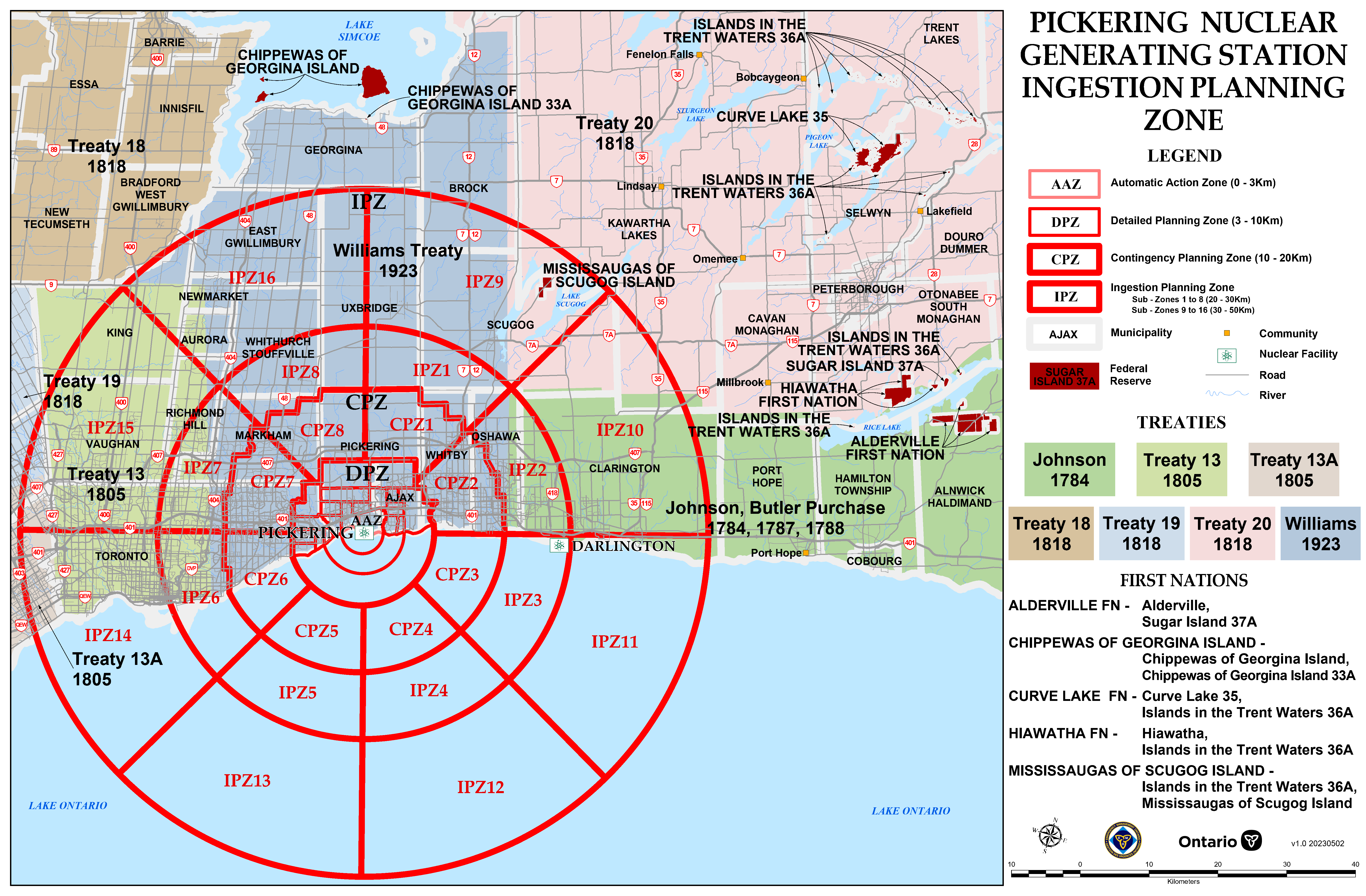
Source: Emergency Management Ontario
Figure 1: Text version
A map of the Greater Toronto Area, centered on the Pickering Nuclear Generating Station Ingestion Planning Zone. The map displays the following zones: the automatic action zone (AAZ), which is a circular area covering a 3-km range around the station; the detailed planning zone (DPZ), which is a circle covering an area 3 to 10 km away from the station; the contingency planning zone (CPZ), which covers an area from 10 to 20 km away; and the ingestion planning zone (IPZ), which covers the area 20 to 50 km away.
The map shows the location of these treaties:
- Johnson, 1784
- Treaty 13, 1805
- Treaty 13A, 1805
- Treaty 18, 1818
- Treaty 19, 1818
- Treaty 20, 1818
- Williams, 1923
It also shows the location of these First Nations:
- Alderville FN – Alderville, Sugar Island 37A
- Chippewas of Georgina Island FN – Chippewas of Georgina Island, Chippewas of Georgina Island 33A
- Curve Lake FN – Curve Lake 35, Islands in the Trent Waters 36A
- Hiawatha FN – Hiawatha, Islands in the Trent Waters 36A
- Mississaugas of Scugog Island FN – Islands in the Trent Waters 36A, Mississaugas of Scugog Island
Figure 2. Darlington Nuclear Generating Station Ingestion Planning Zone
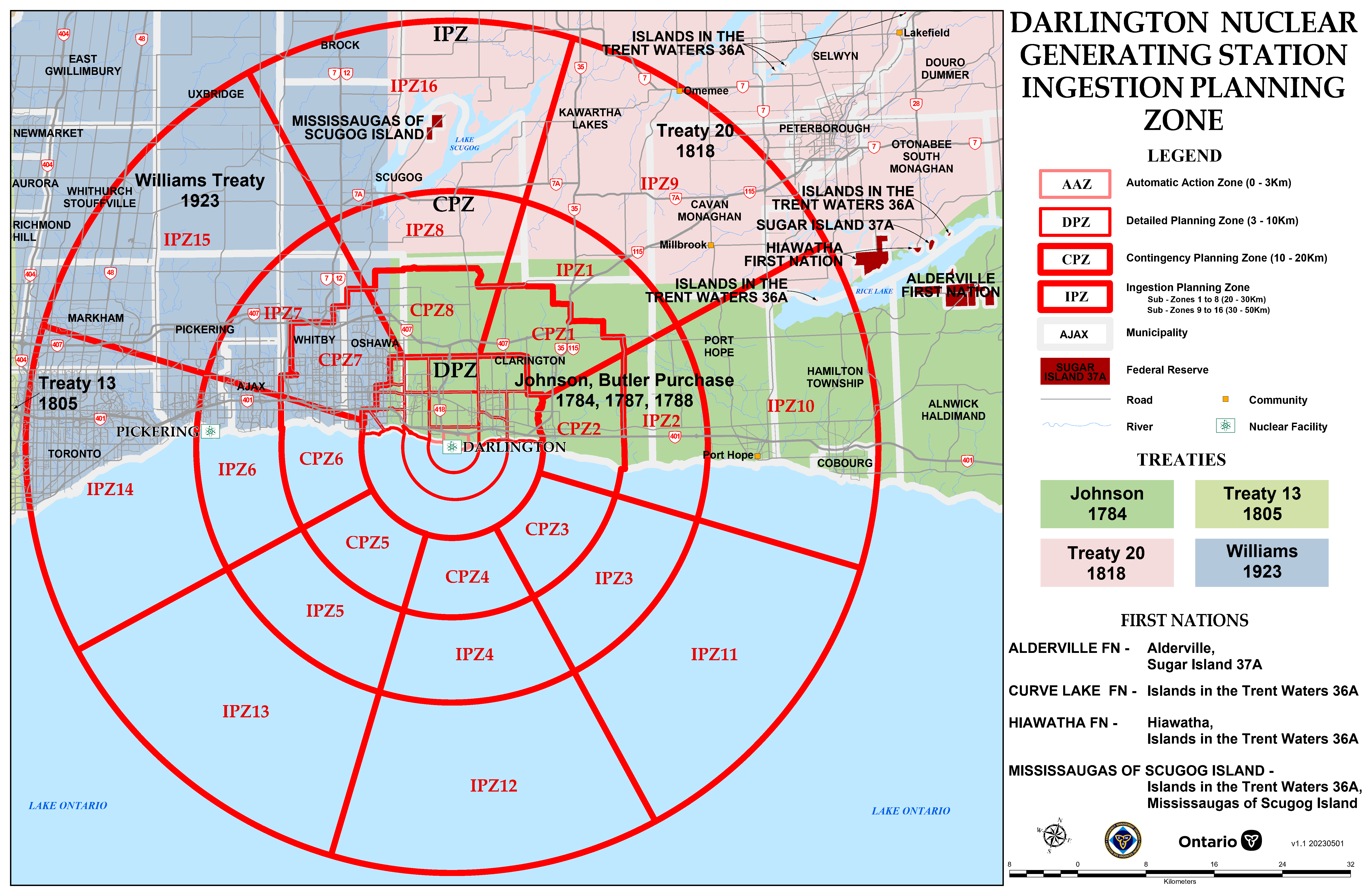
Source: Emergency Management Ontario
Figure 2: Text version
A map of the Greater Toronto Area, centered on the Darlington Nuclear Generating Station Ingestion Planning Zone. The map displays following zones: the automatic action zone (AAZ); the detailed planning zone (DPZ), which is a circular-shaped area covering a range of 3 to 10 km away from the station; the contingency planning zone (CPZ), which covers an area of 10 to 20 km away; and the ingestion planning zone (IPZ), which covers the area 20 to 50 km away.
The map shows the location of these treaties:
- Johnson, 1784
- Treaty 13, 1805
- Treaty 20, 1818
- Williams, 1923
It also shows the location of these First Nations:
- Alderville FN – Alderville, Sugar Island 37A
- Curve Lake FN – Islands in the Trent Waters 36A
- Hiawatha FN – Hiawatha, Islands in the Trent Waters 36A
- Mississaugas of Scugog Island FN – Islands in the Trent Waters 36A, Mississaugas of Scugog Island
What is KI
Potassium iodide, also called KI, is a salt of stable (non-radioactive) iodine. In the event of a nuclear emergency, KI can be ingested so that it would be absorbed into the thyroid gland thus preventing the uptake of radioiodine from being absorbed into the thyroid gland. By blocking the absorption of radioiodine in the thyroid, KI is effective in reducing the threat of thyroid cancer for residents at risk of inhaling or ingesting radioactive iodine.
The CNSC established regulatory requirements for nuclear power plant licensees to ensure that KI pills are pre-distributed to everyone within 10 km of all power plants. Regional, municipal, and provincial authorities responsible for emergency management are responsible for the distribution of the KI pills.
Phase I of the Working Group
Phase I of the Working Group was completed on January 26, 2023, when CNSC staff presented the Phase I report to the Commission at a public meeting.
The objective of Phase I, as outlined in the terms of reference, was to fulfill a commitment to the Commission to clarify the following:
- existing provincial and federal plans for the distribution of KI pills
- considerations and education concerning KI pill emergency distribution in the IPZ
- means of KI pill distribution in relation to other factors associated with a nuclear emergency response
- availability and scope of public emergency preparedness information
Phase II of the Working Group
In August 2022, EMO, in conjunction with the MOH, proposed a revised approach to Phase II, where EMO would lead Phase II and consider the associated objectives while drafting the 2023 update to the Provincial Nuclear Emergency Response Plan (PNERP). The objectives of Phase II include the following:
- determine the feasibility of pre-distribution of KI pills to all schools within the IPZ
- establish clear and detailed plans for the distribution of KI pills throughout the IPZ, if necessary, following the completion of Phase I
In October 2022, senior management of the signatory organizations agreed to EMO’s revised approach to Phase II. The CNSC will remain the chair of the Working Group and will facilitate meetings in support of EMO’s completion of Phase II.
The most recent meeting of the Working Group took place on July 15, 2025. During this meeting, EMO informed the Working Group that revision of the PNERP was ongoing and once the PNERP was completed, the site-specific implementation plans for each nuclear plant would be updated. At that time, the working group would also be asked to reconvene and a way forward discussed about the distribution and stockpiling of KI with the new plans in place.
On July 31, 2025, the PNERP was signed, approved, and ordered by the Government of Ontario. This plan was based on a scientific and technical review performed by EMO. EMO has now commenced revising the site-specific implementation plans.
CNSC Advisory Committee
The purpose of the CNSC Advisory Committee is to ensure that opportunities are provided for meaningful engagement on the outputs of the CNSC KI Pill Working Group. The Advisory Committee includes representatives from the Canadian Environmental Law Association, Toronto District School Board, Toronto Catholic District School Board, Bruce Power, the Municipality of Kincardine, and academia. The Advisory Committee is expected to review the key deliverables of the Working Group (i.e., terms of reference, Phase I report, Phase II report) and advise as to whether the mandate of the Working Group as defined in the terms of reference has been achieved. Operating procedures were developed to establish the framework and guiding principles of the Advisory Committee’s role with respect to the Working Group.
To align with the new approach to Phase II, the CNSC Advisory Committee intended to hold a meeting during the public review period for the 2023 update to the PNERP. This was intended to provide an opportunity for members to engage and discuss the updated PNERP so that each member could submit their respective comments to EMO as part of the public review. This meeting did not take place since a public consultation did not take place prior to the issuance of the revised PNERP.
Meeting minutes for Phase 1
KI Pill Working Group
- August 15, 2019
- October 16, 2019
- November 4-5, 2019
- December 20, 2019
- February 13, 2020
- November 5 and 10, 2020
- September 28, 2021
CNSC Advisory Committee
For more information, please contact info@cnsc-ccsn.gc.ca.
Related links
Page details
- Date modified: