
The Canadian Nuclear Safety Commission’s 2026-27 Departmental Plan
On this page
Copyright information
© His Majesty the King in Right of Canada, as represented by the Minister of Energy and Natural Resources, 2026
Catalogue Number: CC171-28E-PDF
Aussi disponible en français sous le titre : Plan ministériels 2026-2027 Commission canadienne de sûreté nucléaire
At a glance
This departmental plan details the Canadian Nuclear Safety Commission (CNSC)’s priorities, plans, and associated costs for the upcoming three fiscal years. These plans align with the priorities outlined in the CNSC’s mandate, vision, and mission.
Key priorities
The CNSC identified the following key priorities for 2026–27:
- Maintaining rigorous oversight by ensuring a focus on regulating existing facilities and activities
- Ensuring readiness to address new challenges, like new technologies and the need to engage new communities, including Indigenous Nations and communities
- Committing to talent development and improved efficiency to ensure that work is aligned and impactful, and that the organization is equipped with the right skills, learning opportunities and processes
- Supporting these efforts with a culture that ensures that the right workplace behaviours and practices are in place to address organizational priorities
Comprehensive Expenditure Review
The Canadian Nuclear Safety Commission does not have planned reductions under the Comprehensive Expenditure Review.
The CNSC will, however, respect the spirit of the exercise by doing the following:
- reducing its reliance on strategic advisory firms (having previously reduced dependence on information technology contractors)
- engaging in international nuclear activities virtually, where possible, after reviewing and rationalizing the extent of travel required in support of these obligations
- making more efficient use of our accommodations and other administrative support costs
This departmental plan reflects these measures.
Highlights for the CNSC in 2026-27
To achieve its priorities of maintaining robust oversight of Canada’s existing reactor fleet and ensuring readiness for the future, the CNSC will modernize Commission proceedings and strengthen engagement with new communities in 2026–27.
As part of the attention to oversight, the CNSC will modernize Commission proceedings. The CNSC will focus on managing more complex proceedings, reinforcing its ability to efficiently regulate Canada’s existing and new nuclear facilities and activities.
The CNSC’s focus on readiness means anticipating and engaging with new communities, such as Indigenous Nations and communities, by building and fostering strong relationships. This work will build trust in the regulatory process, increase efficiency, and create pathways for transparency and information sharing, thus ensuring that the CNSC is prepared to regulate new nuclear projects and technologies.
In 2026–27, total planned spending (including internal services) for the CNSC is $207,287,306 and total planned full-time equivalent staff (including internal services) is 1,100.
Summary of planned results
The following provides a summary of the results the department plans to achieve in 2026–27 under its main areas of activity, called “core responsibilities.”
-
Core responsibility 1: Nuclear Regulation
The CNSC regulates the development, production and use of nuclear energy and substances to protect the health, safety, and security of persons and the environment; implements Canada’s international commitments on the peaceful use of nuclear energy; and disseminates objective scientific and regulatory information to members of the public. The CNSC maintains a regulatory framework and conducts licensing (including environmental protection reviews), compliance verification and enforcement. The CNSC is committed to building and maintaining the confidence of the public and Indigenous peoples through transparent, open, and inclusive regulatory processes.
Departmental results:
- The environment is protected from releases from nuclear facilities.
- Canadians are protected from radiation resulting from nuclear facilities and activities.
- Nuclear material and substances, facilities and activities are secure and used for peaceful purposes.
- Canadians, including Indigenous peoples, have meaningful information about, and the opportunity to participate in, the nuclear regulatory process.
- Planned spending: $144,019,892
- Planned human resources: 759
For complete information on CNSC’s total planned spending and human resources, read the Planned spending and human resources section of the full plan.
From the President
I am pleased to present the Canadian Nuclear Safety Commission’s (CNSC) 2026–27 Departmental Plan. This document informs Parliamentarians and Canadians about how we will deliver on our important work in the year ahead and reflects our unwavering commitment to protecting the environment and to ensuring nuclear safety and security for all people in Canada.
Interest in nuclear is growing across Canada, with both small- and large-scale nuclear projects on the horizon. Our renewed Strategic Plan positions us to meet the moment while continuing to fulfill our core mission and mandate. In addition, it aligns our efforts with Government of Canada priorities, ensuring regulatory efficiency is an ongoing focus while delivering on our primary objective of ensuring that all nuclear activities in Canada are conducted with safety as a top priority.
We demonstrated our commitment to regulatory efficiency and leadership by being the first regulator in a G7 country to issue a licence to construct a new nuclear project – the Darlington New Nuclear Project (DNNP) – within 24 months. This achievement highlights our ability to deliver rigorous, timely and effective regulatory processes.
We will continue to apply the same high standards for safety, security, environmental protection and Indigenous consultation while meeting designated timelines efficiently and effectively. To help us achieve this, the work we undertook as part of the broader Government of Canada Red Tape Review identified efficiencies and opportunities to reduce administrative burden, with a number of actions already in progress for this fiscal year. We will continue to seek out innovative ideas and different ways of working, and we welcome feedback and input from Indigenous Nations and communities along with other interested parties on where we can improve.
We are prepared for the future and ready to address the regulatory implications of small modular reactors and fusion technologies. We remain agile and continue to maintain robust frameworks that support innovation while safeguarding safety and security. This agility is necessary as it allows us to anticipate change and adapt our regulatory approach to emerging technologies.
This year, we will continue our regulatory oversight of existing licensed facilities and activities through onsite inspections, environmental reviews and other compliance activities. We also remain ready for new project applications as they arise while overseeing licence renewals for major facilities, including large-scale refurbishment projects – ensuring rigorous review and oversight throughout these processes.
At the same time, we will invest in strengthening trust and transparency through meaningful and ongoing engagement with Indigenous Nations and communities, advancing reconciliation and upholding the honour of the Crown and our constitutional responsibilities respecting consultation and accommodation. We will also continue to expand access to regulatory information and data through digital platforms and Open Government initiatives, making our processes even more transparent and accessible for all people in Canada.
The Commission’s calendar for public proceedings remains very active, with several in-person hearings already planned for 2026–27, including applications related to the Pickering Nuclear Generating Station, BWXT’s Toronto and Peterborough nuclear fuel facilities,Cameco’s Port Hope Conversion Facility, and Ontario Power Generation’s Western Waste Management Facility. The Commission continues to modernize its processes, ensuring that they are inclusive and respectful and support public awareness, and to provide clear procedural guidance in support of meaningful public participation in Commission proceedings.
As we look ahead, we remain steadfast in our mission: to regulate nuclear energy and materials to protect health, safety, security, and the environment, and to implement Canada’s international commitments on the peaceful use of nuclear energy. Our highly skilled and professional staff are committed to the actions and work outlined in this plan – working to strengthen trust, foster innovation, and ensure that Canada’s nuclear sector continues to operate safely and responsibly.

Pierre Tremblay
President
Plans to deliver on core responsibilities and internal services
Core responsibilities and internal services
Core responsibility 1: Nuclear Regulation
In this section
Description
The CNSC regulates the use of nuclear energy and materials to protect the health, safety, security of persons and the environment; to implement Canada’s international commitments on the peaceful use of nuclear energy; and to disseminate objective scientific, technical and regulatory information to the public. The CNSC maintains a regulatory framework and conducts licensing activities (including environmental protection reviews) and compliance verification and enforcement. It is committed to building and maintaining the confidence of the public and Indigenous Nations and communities through transparent, open, and inclusive regulatory processes.
The Commission is a quasi-judicial administrative tribunal set up at arm’s length from government, independent from any political, government or private sector influence. It makes decisions with respect to regulating nuclear safety, including licensing decisions. The CNSC reports to Parliament through the Minister of Energy and Natural Resources. The CNSC's arms-length governance structure, and in particular the Commission's arms-length decision-making authority, ensures that the organization remains independent from government and licensees.
Quality of life impacts
Nuclear Regulation contributes to the “environment” domain of the Quality of Life Framework for Canada and, more specifically, “natural disasters and emergencies” through all of the activities mentioned in the core responsibility description.
Indicators, results and targets
This section presents details on the department’s indicators, the actual results from the three most recently reported fiscal years, the targets and target dates for Nuclear Regulation. Details are presented by departmental result.
Table 1: The environment is protected from releases from nuclear facilities.
Table provides a summary of the target and actual results for each indicator associated with the results under Nuclear Regulation.
| Departmental Result Indicators | Actual Results | 2026–27 Target | Date to achieve target |
|---|---|---|---|
| Number of instances of radiological releases that exceeded regulatory limits |
|
0 | March 2027 |
| Number of instances of hazardous releases that exceeded regulatory limits |
|
≤5 | March 2027 |
| Percentage of Independent Environmental Monitoring samples (food, water, air, soil, sediment, sand, and vegetation) that met guidelines |
|
≥95% | March 2027 |
Table 2: Canadians are protected from radiation resulting from nuclear facilities and activities.
Table 2 provides a summary of the target and actual results for each indicator associated with the results under Nuclear Regulation.
| Departmental Result Indicators | Actual results | 2026–27 Target | Date to achieve target |
|---|---|---|---|
| Number of radiation doses to members of the public that exceeded regulatory limits |
|
0 | March 2027 |
| Number of radiation doses to workers that exceeded regulatory limits |
|
0 | March 2027 |
Table 3: Nuclear material and substances, facilities and activities are secure and used for peaceful purposes.
Table 3 provides a summary of the target and actual results for each indicator associated with the results under Nuclear Regulation.
| Departmental Result Indicators | Actual results | 2026–27 Target | Date to achieve target |
|---|---|---|---|
| Number of radiation doses to members of the public that exceeded regulatory limits |
|
0 | March 2027 |
| Number of radiation doses to workers that exceeded regulatory limits |
|
≤2 | March 2027 |
| Number of radiation doses to workers that exceeded regulatory limits |
|
IAEA broader conclusion | Juen 2026 |
Table 4: Canadians, including Indigenous peoples, have meaningful information about, and the opportunity to participate in, the nuclear regulatory process.
Table 4 provides a summary of the target and actual results for each indicator associated with the results under Nuclear Regulation.
| Departmental Result Indicators | Actual results | 2026–27 Target | Date to achieve target |
|---|---|---|---|
| Percentage of Commission proceedings that were accessible to members of the public and Indigenous peoples |
|
≥90% | March 2027 |
| Percentage of Commission proceedings for which the Participant Funding Program was made available to members of the public and Indigenous peoples |
|
≥90% | March 2027 |
| Percentage of Commission proceedings documents that were available in a timely manner on the CNSC website upon request by members of the public and Indigenous peoples |
|
≥90% | March 2027 |
| Number of self-identified Indigenous Nations, communities and organizations who participated in CNSC proceedings |
|
Stable or increasing trend | March 2027 |
Additional information on the detailed results and performance information for the CNSC’s program inventory is available on GC InfoBase.
Plans to achieve results
The following section describes the planned results for Nuclear Regulation in 2026–27.
The environment is protected from releases from nuclear facilities
And...
Canadians are protected from radiation resulting from nuclear facilities and activities.
The CNSC regulates nuclear facilities and activities to ensure that the environment is protected from radiological and hazardous releases and that all people in Canada are protected from radiation. The CNSC’s risk-based regulatory framework ensures that oversight is focused on the highest-risk activities, while recognizing that licensees are ultimately responsible for safety.
The CNSC verifies licensee compliance with its requirements, which are designed to protect the environment and the public. To achieve this planned result, the CNSC identifies, monitors, and controls risk across all nuclear facilities and activities. These licensing and compliance activities are conducted by CNSC inspectors who verify compliance of nearly 1,650 licensees across various sectors.
Results we plan to achieve:
- Conduct licence reviews of New Brunswick Power's new reactor project, Bruce Power's Bruce C Nuclear Project, Energy Alberta's Peace River nuclear power project, the Nuclear Waste Management Organization’s Deep Geological Repository project, and Ontario Power Generation’s new nuclear at Wesleyville within Canadian legislated timelines, building on the experience of issuing a licence to construct for the Darlington New Nuclear Project
- Review and amend, as necessary, REGDOC-2.10.1, Nuclear Emergency Preparedness and Response, to help ensure that the CNSC remains prepared to regulate in the event of a nuclear emergency and that licensees have clarity on the requirements for their own nuclear emergency management programs (this review complements the continued readiness of the CNSC Emergency Operations Centre and Duty Officer line, and the ongoing evaluation of licensee nuclear emergency exercises)
- Continue to manage the Natural Science and Engineering Research Council of Canada’s CNSC Small Modular Reactor (SMR) Research Grant Initiative to grow research capacity related to SMRs.
- Conduct sampling campaigns at select nuclear sites under the Independent Environmental Monitoring Program to verify that the public and the environment around licensed nuclear facilities are protected
Nuclear material and substances, facilities and activities are secure and used for peaceful purposes.
Through its authority under the Nuclear Safety and Control Act (NSCA), the CNSC implements Canada’s international commitments related to nuclear security and the peaceful use of nuclear energy. The CNSC implements regulatory programs to ensure that CNSC licensees and Canada at large meet the obligations arising from the Treaty on the Non-Proliferation of Nuclear Weapons, including international safeguards agreements with the International Atomic Energy Agency (IAEA) and export controls obligations. Safeguards conclusions drawn by the IAEA assure all people in Canada and the international community that all nuclear materials in Canada are used for peaceful purposes. Likewise, the CNSC implements regulatory programs to ensure that CNSC licensees and Canada at large meet the requirements for nuclear security under the Convention for the Physical Protection of Nuclear Material and its amendments
Results we plan to achieve:
- Build on the repeal and replacement of the Nuclear Security Regulations and the amendments to the General Nuclear Safety and Control Regulations and the Nuclear Non-Proliferation Import and Export Control Regulations completed in Fall 2025 to begintheirimplementation with licensees. The updated regulations streamline and improve regulatory requirements by removing barriers to the adoption of new technology and reduce unnecessary burdens and inefficiencies for exporters and importers.
- Ensure that licensees maintain adequate and effective security programs to protect against theft or sabotage of nuclear material and facilities. In addition to inspections and oversight, the CNSC will continue its program of performance testing (force-on-force exercises) with licensees, testing the preparedness of their security plans and physical protection systems by simulating adversarial actions involving the specialized Canadian Adversary Testing Team (CATT).
Canadians, including Indigenous peoples, have meaningful information about, and the opportunity to participate in, the nuclear regulatory process.
The CNSC actively encourages participation by the public and Indigenous Nations and communities in its regulatory processes. Public hearings and meetings are open to the public, are sometimes held in the host community, and are always webcast live on the CNSC website. In addition, the CNSC offers funding through its Participant Funding Program to help support the participation of Indigenous Nations and communities, members of the public, and other interested parties in bringing valuable information to the Commission.
Results we plan to achieve:
- Leverage Open Government and the Open Science and Data platforms, and the Regional Information and Monitoring Network for the Ottawa River Watershed (RIMNet) to share data with people in Canada
- Continue to hold dedicated engagement sessions with Indigenous Nations and communities and promote early engagement and opportunities to contribute during the licensing process, including consultations and community outreach
- Continue work to improve public-facing web forms to increase usability, ensure data quality and align with digital service standards; foundational work to improve the CNSC’s digital services will enable seamless digital business with licensees, Indigenous Nations and communities, government, international partners, and the public
- Consult and complete publication of the update to REGDOC-3.2.2, Indigenous Engagement (this new draft reflects current expectations and requirements for CNSC licensees on Indigenous engagement, including aligning with the principles of the United Nations Declaration on the Rights of Indigenous Peoples)
- Help Indigenous Nations and communities and interested parties gain capacity to engage in CNSC regulatory processes, prior to and throughout the lifecycle of nuclear facilities and activities in Canada by continuing to provide a Participant Funding Program and Indigenous and Stakeholder Capacity Fund
- Update the Packaging and Transport of Nuclear Substances Regulations, 2015 (PTNSR 2015) to facilitate the transport of uranium and thorium ores; any amendments will be informed by the feedback received through the Supply Chain Regulatory Review consultation on international alignment, led by Treasury Board, as well as the regulations’ amendment process, while ensuring that the PTNSR 2015 continue to protect the health and safety of workers, the public and the environment
Gender-based Analysis Plus
The CNSC integrates gender-based analysis plus (GBA Plus) into work-related areas where the Government of Canada has established GBA Plus requirements. These areas are:
- the development, implementation, and review of regulations
- the conduct of evaluations
- the development of cabinet proposals (such as Treasury Board submissions and memoranda to Cabinet)
The CNSC may expand the application of GBA Plus beyond the mandated areas to other activities where its application is relevant, such as policies that support a hybrid workforce, the regulatory framework, Indigenous engagement, and other engagement or outreach activities. The decision to undertake a GBA Plus assessment in corporate activities is determined on a case-by-case basis.
Planned resources to achieve results
Table 5: Planned resources to achieve results for Nuclear Regulation
Table 5 provides a summary of the planned spending and full-time equivalents required to achieve results.
| Resource | Planned |
|---|---|
| Spending | 144,019,892 |
| Full-time equivalents | 759 |
Complete financial and human resources information for the CNSC’s program inventory is available on GC InfoBase.
Program inventory
Nuclear Regulation is supported by the following programs:
- Nuclear Fuel Cycle
- Nuclear Reactors
- Nuclear Substances and Prescribed Equipment
- Nuclear Non-Proliferation
- Scientific, Regulatory and Public Information
Additional information related to the program inventory for Nuclear Regulation is available on the Results page on GC InfoBase.
Summary of changes to reporting framework since last year
Changes were made to the wording of a departmental results indicator under the result “Nuclear material and substances, facilities and activities are secure and used for peaceful purposes" to include more specific information about what the indicator measures and provide greater clarity for Parliamentarians and all people in Canada.
Internal services
In this section
Description
Internal services are the services that are provided within a department so that it can meet its corporate obligations and deliver its programs. There are 10 categories of internal services:
- acquisition management services
- communications services
- financial management services
- human resources management services
- information management services
- information technology services
- legal services
- materiel management services
- management and oversight services
- real property management services
Plans to achieve results
This section presents details on how the department plans to achieve results and meet targets for internal services.
In 2026–27, the CNSC’s internal services will enable it to deliver on its programs and achieve its departmental results by:
- modernizing human resources and information technology infrastructure by participating as 1 of the 3 pilot organizations for the Government of Canada’s HR and Pay Transformation Initiative
- continuing to modernize the operations planning process to improve the alignment of regulatory activities and resources
- advancing implementation of the CNSC’s Strategic Workforce Plan (2024–29) to ensure that the organization has the right skills and learning opportunities to prepare for innovation and growth in the sector; for 2026–27, the CNSC will focus on fostering a continuous learning environment and opportunities for leadership development, and updating workforce planning resources
Planned resources to achieve results
Table 6: Planned resources to achieve results for internal services this year
Table 6 provides a summary of the planned spending and full-time equivalents required to achieve results.
| Resource | Planned |
|---|---|
| Spending | 63,267,414 |
| Full-time equivalents | 341 |
Complete financial and human resources information for the CNSC’s program inventory is available on GC InfoBase.
Planning for contracts awarded to Indigenous businesses
To meet the mandatory 5% target of the total value of contracts awarded annually to Indigenous businesses, as outlined in appendix E of the Directive on the Management of Procurement, the CNSC is adopting a strategic and proactive approach.
Indigenous procurement objectives will be embedded into annual procurement planning, and procurement processes will be adjusted to support Indigenous participation. Where feasible, contracts will be allocated specifically for Indigenous businesses, and competitive processes will be designed to encourage Indigenous suppliers. The CNSC will also leverage existing standing offers and supply arrangements that include Indigenous sources.
Table 7: Percentage of contracts planned and awarded to Indigenous businesses
Table 7 presents the current, actual results with forecasted and planned results for the total percentage of contracts the department awarded to Indigenous businesses.
| 5% reporting field | 2024–25 actual result | 2025–26 forecasted result | 2026–27 planned result |
|---|---|---|---|
| Total percentage of contracts with Indigenous businesses | 17.32% | 5% | 5% |
The difference between the reported results and those in the 2024–25 Departmental Result Report (DRR) is due to adjustments made to the total contract value. However, the total value of Indigenous contracts has not changed.
Department-wide considerations
In this section
Related Government Priorities
United Nations 2030 Agenda for Sustainable Development and the UN Sustainable Development Goals
The CNSC’s policies and processes for consultation, engagement and collaboration with Indigenous Nations and communities, including its Indigenous Knowledge Policy Framework, support the Government of Canada’s implementation of the United Nations Declaration on the Rights of Indigenous Peoples. The CNSC maintains a regulatory framework and is committed to building and maintaining the confidence of the public and Indigenous Nations and communities through transparent, open and inclusive regulatory processes. It conducts licensing activities (including environmental protection reviews) and verifies and enforces licensee compliance with regulatory requirements.
The CNSC is also committed to consulting and engaging with Indigenous Nations and communities, with a focus on advancing reconciliation. It continues to evolve its approach to consultation and engagement with Indigenous Nations and communities through the adoption of best practices, including encouraging participation in the Indigenous and Stakeholder Capacity Fund, enabling participation in regulatory processes through the Participant Funding Program, and establishing relationship terms of reference with Indigenous communities.
The CNSC contributes to Sustainable Development Goals 7, 10,12, 13, and 16. More information on the CNSC’s contributions to Canada’s Federal Implementation Plan on the 2030 Agenda and the Federal Sustainable Development Strategy can be found in the CNSC’s Departmental Sustainable Development Strategy 2023 to 2027.
Artificial Intelligence
In fiscal year 2026–27, the CNSC will continue to explore and pilot artificial intelligence (AI) technologies. These efforts will assess the potential of AI to support the CNSC's work and inform a more structured and scalable deployment plan in future fiscal years. These foundational efforts demonstrate the CNSC's commitment to preparing the organization for the safe and effective use of AI.
Key Risks
Risk management is a fundamental part of the CNSC’s mission to protect health, safety, security and the environment; to implement Canada’s international commitments on the peaceful use of nuclear energy; and to disseminate objective scientific, technical and regulatory information to the public. The CNSC has identified the following risks as part of an annual exercise to identify risks and implement mitigation activities:
Nuclear reactor accident
Design of nuclear reactors applies a defence-in-depth approach that anticipates and mitigates many potential challenges caused by both internal and external events. However, a remote possibility remains that an event can lead to an accident unless effectively mitigated. Through its robust compliance program, the CNSC ensures that licensees have programs, personnel and equipment to respond to and manage any type of accident at their facilities.
Activities carried out by the CNSC include:
- continued risk-informed oversight at the facilities through a mature compliance program
- review of operational experience and evaluation of corrective actions in response to events
- overseeing licensees’ emergency management plans and programs, including full-scale emergency exercises
- maintaining its duty officer program
- conducting drills at its Emergency Operations Centre
- undertaking research projects, through the Research and Support program, to support science-based regulatory practices
Malevolent activities
Canadian nuclear facilities and nuclear and radioactive substances (including waste) may be the target of malevolent acts. It is also possible for nuclear and/or radioactive substances, equipment or technologies to be diverted or stolen and used for non-peaceful or malevolent purposes. With increased cyber-attacks worldwide and in all sectors, the CNSC must provide regulatory oversight to ensure that licensees’ security and safeguards programs are robust. The CNSC also maintains a strong import and export licensing program to ensure that trade in nuclear substances, equipment, and technology respects security, safety, safeguards, and non-proliferation requirements. To reduce risk, the CNSC:
- maintains a robust regulatory framework and works with nuclear operators, law enforcement and intelligence agencies, international organizations and other government departments to ensure that nuclear materials and facilities are adequately protected as outlined in Canada’s Nuclear Security Regulations
- ensures nuclear material inventories are properly tracked and reported to the CNSC and verified
Transportation accidents
The responsibility for regulatory oversight of the safe transport of nuclear substances is shared between the CNSC via the Packaging and Transport of Nuclear Substance Regulations, 2015 and Transport Canada, under the Transportation of Dangerous Goods Regulations (TDGR). While the transport of nuclear substances in Canada continues to remain a safe activity, there is always a risk that packages containing nuclear substances can be involved in motor vehicle accidents. To mitigate this risk, the CNSC:
- requires the use of packages that are designed according to the risk posed by the material being transported, with high-risk nuclear material requiring robust packaging that has been certified by the CNSC to withstand severe transport accidents
- provides guidance, including 3 regulatory documents in the REGDOC-2.14, Packaging and Transport, series
- provides information support to first responders, who are trained in hazardous materials and use the North American Emergency Response Guide to respond to accidents involving nuclear substances (high-risk nuclear material in appropriate packaging may also require an emergency response assistance program as per TC/TDGR requirements, which ensure expert-level assistance or guidance in case of a shipping accident)
Nuclear fuel cycle facility accident/event
An accident or event could lead to accidental releases of radiological, industrial or chemical hazards. The NSCA and regulations impose strict controls to prevent accidents or events, which are further minimized by CNSC’s compliance programs and activities. To mitigate the risk of a nuclear fuel cycle facility accident or event, the CNSC:
- provides clear and structured licences and licence conditions handbooks
- maintains a robust compliance program
- shares best practices and information on significant events with other regulators and international peer review groups
Readiness for new technology
The innovative technologies being adopted or emerging in the nuclear sector pose a risk in that the CNSC may not have the expertise necessary to regulate such technologies. The CNSC’s capacity, capability and regulatory framework must be agile and flexible enough to keep pace with new technologies (including SMRs) as they apply to the nuclear sector in Canada, to ensure safety and security and avoid impeding innovation. To mitigate the risk of not keeping pace and to increase its readiness, the CNSC:
- has developed and implemented a comprehensive strategy for readiness to regulate new reactor technologies
- has identified strategic objectives for its regulatory framework related to new technologies, including regulations and regulatory documents
- is leveraging the Government of Canada’s $50 million 2022–27 budget allocation to support its ability to regulate advanced reactor technologies by building capacity to assess expected SMR licence applications
- is implementing a strategic workforce plan, including hiring new employees and preparing teams to develop capacity on readiness for SMRs
- is including considerations for regulating fusion technology, which is expected to be a future source of clean energy, as part of the review and revision to the Class II Nuclear Facilities and Prescribed Equipment Regulations
- consults with domestic and international regulatory partners to ensure the sharing of training resources and expertise
-
leverages the Chief Science Officer in developing and maintaining its science capability, including:
- administration of the CNSC's Science and Technology Advisory Committee
- continued management of the delivery and improvement of the Inspector Training Qualification Program suite of courses
- conducting training needs assessment for technical staff, in particular staff from the Technical Support and Regulatory Operations branches, identifying immediate and longer-term needs
- continued management of the CNSC's participation in the Research and Support Program, Natural Science and Engineering Research Council of Canada's Small Modular Reactor Research Grant Initiative, and the Federal Nuclear Science and Technology Work Plan
- providing science-informed guidance on AI and other disruptive, innovative, and emerging technologies in the nuclear industry from within the CNSC
Planned spending and human resources
This section provides an overview of CNSC’s planned spending and human resources for the next three fiscal years and of planned spending for 2026–27 with actual spending from previous years.
Spending
This section presents an overview of the department's planned expenditures from 2023–24 to 2028–29.
Budgetary performance summary
Table 8: Three-year spending summary for core responsibilities and internal services (dollars)
Table 8 presents CNSC's spending over the past three years to carry out its core responsibilities and for internal services. Amounts for the 2025–26 fiscal year are forecasted based on spending to date.
| Core responsibilities and internal services | 2023-2024 Actual Expenditures | 2024-25 Actual Expenditures | 2025-2026 Forecast Spending |
|---|---|---|---|
| Nuclear Regulation | 112,048,849 | 138,650,886 | 138,860,121 |
| Subtotal (s) | 112,048,849 | 138,650,886 | 138,860,121 |
| Internal services | 57,995,740 | 63,791,202 | 60,938,614 |
| Total (s) | 170,044,589 | 202,442,088 | 199,798,735 |
Analysis of past three years of spending
The increase from $170.0 million in actual spending in 2023–24 to $202.4 million in 2024–25 is primarily driven by higher personnel costs, including negotiated salary adjustments and retroactive payments for 2022–23 and 2023–24, as well as additional FTEs to support new industry projects. Planned spending is expected to decline slightly to $199.8 million in 2025–26 as retroactive salary payments conclude, partially offset by anticipated increases in FTEs and cost-of-living adjustments.
More financial information from previous years is available on the Finances section of GC Infobase.
Table 9: Planned three-year spending on core responsibilities and internal services (dollars)
Table 9 presents the CNSC’s planned spending over the next three years by core responsibilities and for internal services.
| Core responsibilities and internal services | 2026-27 Planned Spending | 2027-28 Planned Spending | 2028-29 Planned Spending |
|---|---|---|---|
| Nuclear Regulation | 144,019,892 | 145,960,666 | 144,100,557 |
| Subtotal | 144,019,892 | 145,960,666 | 144,100,557 |
| Internal services | 63,267,414 | 64,119,990 | 63,302,850 |
| Total | 207,287,306 | 210,080,656 | 207,403,407 |
Analysis of the next three years of spending
Planned spending is projected to rise from $199.8 million in 2025–26 to $207.3 million in 2026–27, driven by anticipated increases in FTEs and cost-of-living adjustments (including salaries and wages). Spending is expected to grow further to $210.1 million in 2027–28, primarily due to continued cost-of-living increases, partially offset by the sunsetting of Treasury Board Secretariat (TBS) funding for SMR activities. In 2028–29, planned spending is forecast to decline to $207.4 million due to the sunsetting of TBS funding for the Impact Assessment Renewal Initiative, partially offset by ongoing cost-of-living adjustments.
More detailed financial information on planned spending is available on the Finances section of GC Infobase.
Funding
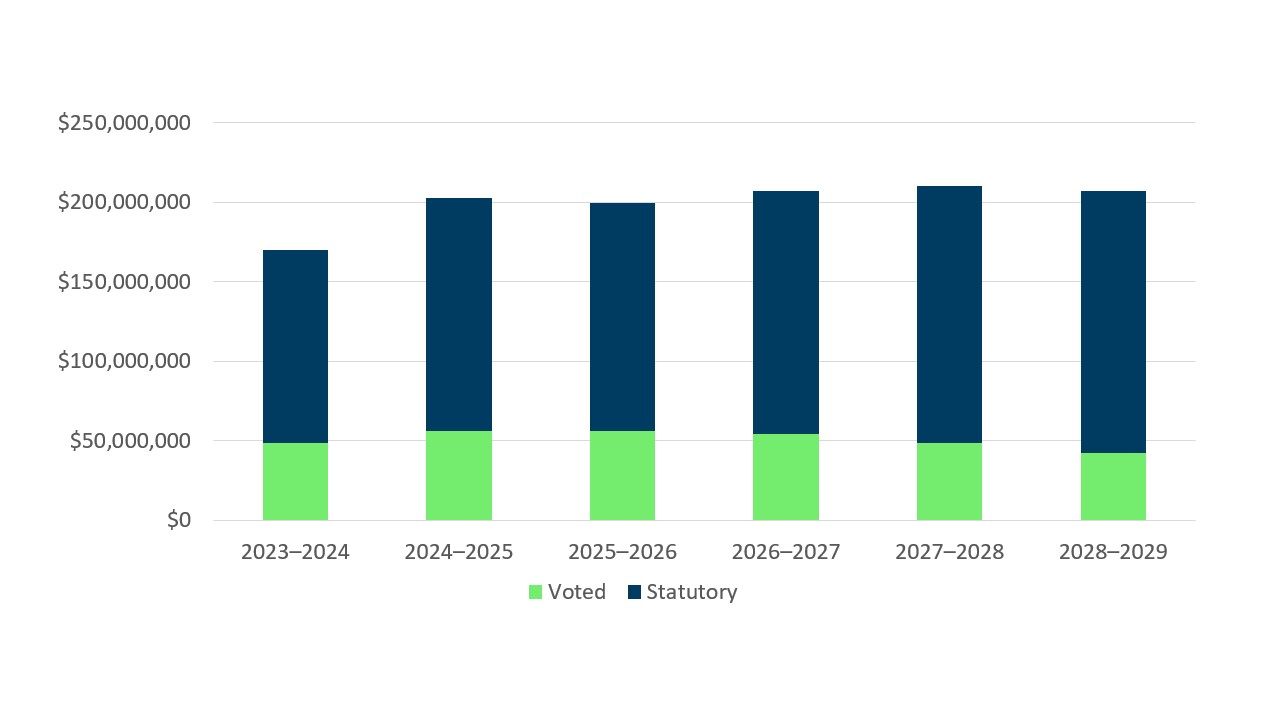
This section provides an overview of the department's voted and statutory funding for its core responsibilities and for internal services. For further information on funding authorities, consult the Government of Canada budgets and expenditures.
Graph 1 summarizes the department's approved voted and statutory funding from 2023–24 to 2028–29.
Text description of graph 1
| Fiscal year | Total | Voted | Statutory |
|---|---|---|---|
| 2023-24 | 170,044,589 | 48,542,441 | 121,502,148 |
| 2024-25 | 202,442,088 | 56,483,609 | 145,958,479 |
| 2025-26 | 199,798,735 | 56,434,000 | 143,364,735 |
| 2026-27 | 207,287,306 | 54,062,479 | 153,224,827 |
| 2027-28 | 210,080,656 | 48,632,450 | 161,448,206 |
| 2028-29 | 207,403,407 | 42,577,717 | 164,825,690 |
Analysis of statutory and voted funding over a six-year period
The CNSC is financed by the Government of Canada through voted parliamentary and statutory financial authorities. Included in the statutory appropriation is a revenue-spending authority, which allows the CNSC to spend most licence fee revenue, as well as funding for contributions to employee benefit plans. The voted authority provides funding for activities exempt from paying fees (i.e., hospitals and universities) and for activities with respect to Canada’s international obligations (including non-proliferation activities), public responsibilities (such as emergency management and public information programs) and updating of the Nuclear Safety Control Act and its associated regulations.
The budgetary performance summary section provides variance explanations of year-to-year fluctuations in spending.
For further information on the CNSC’s departmental appropriations, consult the 2026–27 Main Estimate.
Future-oriented condensed statement of operations
The future-oriented condensed statement of operations provides an overview of CNSC’s operations for 2025–26 to 2026–27.
Table 10: Future-oriented condensed statement of operations for the year ended March 31, 2027 (dollars)
Table 10 summarizes the expenses and revenues which net to the cost of operations before government funding and transfers for 2025–26 to 2026–27. The forecast and planned amounts in this statement of operations were prepared on an accrual basis. The forecast and planned amounts presented in other sections of the Departmental Plan were prepared on an expenditure basis. Amounts may therefore differ.
| Financial information | 2025-26 Forecast results | 2026-27 Planned results | Difference (planned results minus forecasted) |
|---|---|---|---|
| Total expenses | 216,438,000 | 224,096,000 | 7,658,000 |
| Total revenues | 153,577,000 | 160,500,000 | 6,923,000 |
| Net cost of operations before government funding and transfers | 62,861,000 | 63,596,000 | 735,000 |
Analysis of forecasted and planned results
The CNSC’s projected net cost of operations for 2026–27 is $63.6 million, an increase of $0.7 million (1.2%) compared to the 2025–26 forecast. This change reflects a $7.6-million (3.5%) rise in total expenses, primarily driven by higher FTE utilization to support new industry projects and cost-of-living adjustments, including salaries and wages. Total revenues are expected to grow by $6.9 million (4.5%), largely in response to the increase in expenses, as regulatory fees fund most of the CNSC’s operations.
A more detailed Future-Oriented Statement of Operations and associated Notes for 2026–27, including a reconciliation of the net cost of operations with the requested authorities, is available on CNSC’s website.
Human resources
This section presents an overview of the department’s actual and planned human resources from 2023–24 to 2028–29.
Table 11: Actual human resources for core responsibilities and internal services
Table 11 shows a summary of human resources, in full-time equivalents, for the CNSCs core responsibilities and for its internal services for the previous three fiscal years. Human resources for the 2025–26 fiscal year are forecasted based on year to date.
| Core responsibilities and Internal Services | 2023–24 Actual full-time equivalents | 2024–25 Actual full-time equivalents | 2025–26 Actual full-time equivalents |
|---|---|---|---|
| Nuclear Regulation | 644 | 694 | 731 |
| Subtotal | 644 | 694 | 731 |
| Internal services | 324 | 321 | 327 |
| Total | 968 | 1,015 | 1,058 |
Analysis of human resources over the last three years
The increase to 1,015 FTEs in 2024–25 (from 968 FTEs in 2023–24) reflects ongoing efforts to strengthen SMR regulatory readiness and support new industry projects. The forecasted increase to 1,058 FTEs in 2025–26 (from 1,015 FTEs in 2024–25) are a result of new industry projects
Table 12: Human resources planning summary for core responsibilities and internal services
Table 12 shows information on human resources, in full-time equivalents, for each of the CNSC’s core responsibilities and for its internal services planned for the next three years.
| Core responsibilities and internal services | 2026-27 Planned full-time equivalents | 2027-28 Planned full-time equivalents | 2028-29 Planned full-time equivalents |
|---|---|---|---|
| Nuclear Regulation | 759 | 755 | 748 |
| Subtotal | 759 | 755 | 748 |
| Internal services | 341 | 348 | 342 |
| Total | 1,100 | 1,103 | 1,090 |
Analysis of human resources for the next three years
The planned increase to 1,100 FTEs in 2026–27 (up from 1,058 in 2025–26) reflects the ongoing impact of new industry projects. The forecast then anticipates minor adjustments, rising slightly to 1,103 FTEs in 2027–28 before declining to 1,090 FTEs in 2028–29.
Supplementary information tables
The following supplementary information tables are available on CNSC’s departmental website:
Information on the CNSC’s departmental sustainable development strategy can be found on the CNSC’s departmental website.
Federal tax expenditures
The CNSC’s Departmental Plan does not include information on tax expenditures.
The tax system can be used to achieve public policy objectives through the application of special measures such as low tax rates, exemptions, deductions, deferrals and credits. The Department of Finance Canada publishes cost estimates and projections for these measures each year in the Report on Federal Tax Expenditures.
This report also provides detailed background information on tax expenditures, including descriptions, objectives, historical information and references to related federal spending programs as well as evaluations and GBA Plus of tax expenditures.
Corporate information
Departmental profile
Appropriate minister(s):
Tim Hodgson
Institutional head:
Pierre Tremblay
Ministerial portfolio:
Energy and Natural Resources
Enabling instrument(s):
Year of incorporation / commencement:
2000
Departmental contact information
Mailing address:
280 Slater St
PO Box 1045, Stn B
Ottawa ON K1P 5S9
Canada
Telephone:
613-995-5894
TTY:
1-800-926-9105
Fax:
613-995-5086
Email:
Website(s):
Definitions
List of terms
- appropriation (crédit)
- Any authority of Parliament to pay money out of the Consolidated Revenue Fund.
- budgetary expenditures (dépenses budgétaires)
- Operating and capital expenditures; transfer payments to other levels of government, organizations or individuals; and payments to Crown corporations.
- core responsibility (responsabilité essentielle)
- An enduring function or role performed by a department. The intentions of the department with respect to a core responsibility are reflected in one or more related departmental results that the department seeks to contribute to or influence.
- Departmental Plan (plan ministériel)
- A report on the plans and expected performance of an appropriated department over a 3 year period. Departmental Plans are usually tabled in Parliament each spring.
- departmental result (résultat ministériel)
- A consequence or outcome that a department seeks to achieve. A departmental result is often outside departments’ immediate control, but it should be influenced by program-level outcomes.
- departmental result indicator (indicateur de résultat ministériel)
- A quantitative measure of progress on a departmental result.
- departmental results framework (cadre ministériel des résultats)
- A framework that connects the department’s core responsibilities to its departmental results and departmental result indicators.
- Departmental Results Report (rapport sur les résultats ministériels)
- A report on a department’s actual accomplishments against the plans, priorities and expected results set out in the corresponding Departmental Plan.
- full-time equivalent (équivalent temps plein)
- A measure of the extent to which an employee represents a full person-year charge against a departmental budget. For a particular position, the full-time equivalent figure is the ratio of number of hours the person actually works divided by the standard number of hours set out in the person’s collective agreement.
- Gender-based Analysis Plus (GBA Plus) (analyse comparative entre les sexes plus [ACS Plus])
-
Is an analytical tool used to support the development of responsive and inclusive policies, programs, and other initiatives. GBA Plus is a process for understanding who is impacted by the issue or opportunity being addressed by the initiative; identifying how the initiative could be tailored to meet diverse needs of the people most impacted; and anticipating and mitigating any barriers to accessing or benefitting from the initiative. GBA Plus is an intersectional analysis that goes beyond biological (sex) and socio-cultural (gender) differences to consider other factors, such as age, disability, education, ethnicity, economic status, geography (including rurality), language, race, religion, and sexual orientation.
Using GBA Plus involves taking a gender- and diversity-sensitive approach to our work. Considering all intersecting identity factors as part of GBA Plus, not only sex and gender, is a Government of Canada commitment.
- government priorities (priorités gouvernementales)
- For the purpose of the 2026-27 Departmental Plan, government priorities are the high-level themes outlining the government’s agenda in the 2025 Speech from the Throne.
- horizontal initiative (initiative horizontale)
- An initiative where two or more federal departments are given funding to pursue a shared outcome, often linked to a government priority.
- Indigenous business (enterprise autochtones)
- Requirements for verifying Indigenous businesses for the purposes of the departmental result report are available through the Indigenous Services Canada Mandatory minimum 5% Indigenous procurement target website.
- non‑budgetary expenditures (dépenses non budgétaires)
- Non-budgetary authorities that comprise assets and liabilities transactions for loans, investments and advances, or specified purpose accounts, that have been established under specific statutes or under non-statutory authorities in the Estimates and elsewhere. Non-budgetary transactions are those expenditures and receipts related to the government's financial claims on, and obligations to, outside parties. These consist of transactions in loans, investments and advances; in cash and accounts receivable; in public money received or collected for specified purposes; and in all other assets and liabilities. Other assets and liabilities, not specifically defined in G to P authority codes are to be recorded to an R authority code, which is the residual authority code for all other assets and liabilities.
- performance (rendement)
- What a department did with its resources to achieve its results, how well those results compare to what the department intended to achieve, and how well lessons learned have been identified.
- performance indicator (indicateur de rendement)
- A qualitative or quantitative means of measuring an output or outcome, with the intention of gauging the performance of a department, program, policy or initiative respecting expected results.
- plan (plan)
- The articulation of strategic choices, which provides information on how a department intends to achieve its priorities and associated results. Generally, a plan will explain the logic behind the strategies chosen and tend to focus on actions that lead to the expected result.
- planned spending (dépenses prévues)
-
For Departmental Plans and Departmental Results Reports, planned spending refers to those amounts presented in Main Estimates.
A department is expected to be aware of the authorities that it has sought and received. The determination of planned spending is a departmental responsibility, and departments must be able to defend the expenditure and accrual numbers presented in their Departmental Plans and Departmental Results Reports.
- program (programme)
- Individual or groups of services, activities or combinations thereof that are managed together within the department and focus on a specific set of outputs, outcomes or service levels.
- program inventory (répertoire des programmes)
- Identifies all the department’s programs and describes how resources are organized to contribute to the department’s core responsibilities and results.
- result (résultat)
- A consequence attributed, in part, to an department, policy, program or initiative. Results are not within the control of a single department, policy, program or initiative; instead they are within the area of the department’s influence.
- statutory expenditures (dépenses législatives)
- Expenditures that Parliament has approved through legislation other than appropriation acts. The legislation sets out the purpose of the expenditures and the terms and conditions under which they may be made.
- target (cible)
- A measurable performance or success level that an organization, program or initiative plans to achieve within a specified time period. Targets can be either quantitative or qualitative.
- voted expenditures (dépenses votées)
- Expenditures that Parliament approves annually through an appropriation act. The vote wording becomes the governing conditions under which these expenditures may be made.
Page details
- Date modified: