
How the licensing process works
The Canadian Nuclear Safety Commission (CNSC) licensing process involves a series of steps to help ensure the safe use of nuclear energy and materials in Canada.
Licensing process overview
Throughout the lifecycle of regulated nuclear activities, the CNSC:
- engages Indigenous Nations and communities as well as members of the public
- reviews licence applications
- conducts technical assessments
- verifies compliance with regulatory requirements
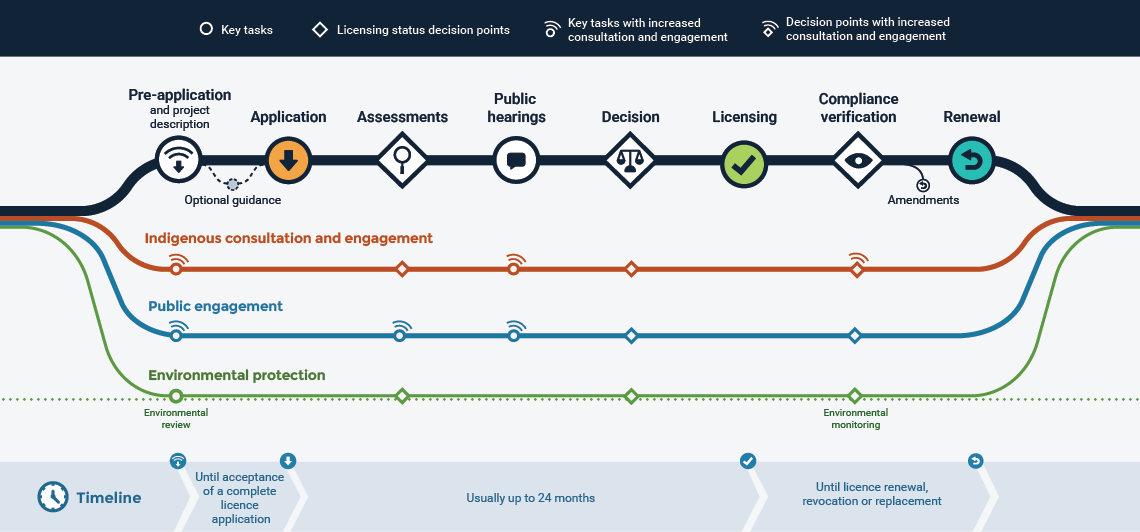
Accessible text description
This text description provides the information shown in the licensing process image.
Legend
The image uses symbols, labels and connecting lines to show the main licensing stages, optional steps, activities that continue throughout the process, and timeline information.
Main stages of the licensing process
- Pre-application and project description
- Application
- Assessments
- Public hearings
- Decision
- Licensing
- Compliance verification and follow-up program
- Renewal
Optional guidance may be available between pre-application and application.
Amendments may happen between compliance verification and renewal.
Key elements integrated throughout the licensing process
- Indigenous consultation and engagement
- Public engagement
- Environmental protection
Timeline
- Between pre-application and application, the timeline proceeds until the applicant has submitted sufficient information to commence the technical assessment.
- Between application and the licence decision, the timeline can be up to 24 months.
- Between licensing and renewal, the timeline proceeds until licence renewal, revocation or replacement.
Additional context
Timelines for specific projects may vary depending on the nature of the project, the completeness of the application, and project-specific regulatory requirements.
Main stages of the licensing process
The licensing process includes several stages. The steps may vary depending on the type of project, facility or regulated activity.
- Pre-application
- Optional guidance
- Application
- Assessments
- Environmental review
- Public hearings
- Decision
- Licensing
- Compliance verification
- Amendments
- Renewal
Pre-application
Applicants or licensees are encouraged to seek CNSC guidance at the earliest possible stage of planning before submitting a licence application to ensure that they understand all regulatory requirements.
As more information is gathered, the CNSC:
- ensures that an adequate Indigenous consultation process is followed
- reviews project descriptions for federally designated projects to assess the potential for environmental impacts (assessing which act applies)
- continues consultations through the full regulatory process and facility lifecycle
Optional guidance
The CNSC offers optional services (at the vendor’s request) to give feedback on new technologies that are in early development.
Application
Depending on where a project is at in its lifecycle, the proponent must submit a licence application for one or more of the following:
- Prepare site
- Construct
- Operate
- Decommission
- Abandon (release from licensing)
- Applications to amend, renew, transfer or revoke a licence may also be submitted.
The licence application needs to consider all regulatory criteria as defined by the Nuclear Safety and Control Act, relevant regulatory requirements and expectations and applicable international and domestic standards.
Assessments
Once an application is received, it is subject to a technical assessment and an environmental review. The CNSC conducts the assessment, engages and seeks to collaborate with Indigenous Nations and communities, and submits recommendations to the Commission in a Commission member document prior to a public Commission proceeding.
An assessment of the potential for environmental effects is needed to determine whether any environmental review legislation applies.
Environmental review
Potential project impacts are assessed to inform the decision-making process and the implementation of a proposed nuclear project before it is licensed. Depending on its location and design, a project may be subject to one of these assessment frameworks:
-
Integrated impact assessment
Legislation: Impact Assessment Act -
Federal lands assessment
Legislation: Impact Assessment Act -
Environmental assessment
Legislation: Canadian Environmental Assessment Act, 2012; applies only to projects initiated before 2019 -
Environmental protection review
Legislation: Nuclear Safety and Control Act -
Provincial assessment or land claim agreement assessment (other jurisdictions)
Legislation: Various
Public hearings
The Commission is an independent, quasi-judicial tribunal that operates at arm’s length from the nuclear industry, and that makes decisions on the licensing of major nuclear facilities through a public hearing process. Indigenous Nations and communities, involved parties, and members of the public have an opportunity to participate in meetings and hearings.
Commission decisions are reviewable by the Federal Court of Canada.
Decision
If a project is a designated project under the Impact Assessment Act, it requires an impact assessment and licensing decision.
For projects falling under the Canadian Environmental Assessment Act, 2012, the Commission will make a decision on the environmental assessment before making a licensing decision.
The Commission must also determine whether the duty to consult and accommodate Indigenous Nations and communities has been met.
Licensing
If a licence is granted, the decision will outline the licence conditions and authorized activities that must be met by the licensee during the defined term of the licence.
For some licence applications, the Commission may designate certain CNSC staff as designated officers (DOs) to carry out licensing and certification decisions for various activities. DO decisions are based on rigorous reviews performed by CNSC staff, who verify whether the applicant meets regulatory requirements.
Compliance verification
If a licence is issued, the CNSC conducts inspections and reviews to verify licensee compliance for the duration of the licence.
Licensees are required to submit routine reports on their activities. The CNSC may also conduct environmental compliance activities in collaboration with Indigenous Nations and communities who express interest.
When a non-compliance (or continued non-compliance) has been identified, the CNSC determines the appropriate enforcement action to encourage compliance and deter future lack of compliance.
Amendments
During the licence period, certain circumstances may require changes to a licence. If a change is needed, proponents must submit a licence amendment application, which would follow the same licensing process.
Renewal
Existing licensees follow the same licensing process when applying for licence renewals. The decision to renew a licence is based on the application and a satisfactory compliance performance.
Elements included throughout the process
Some activities may take place at different stages of the licensing process, depending on the project, facility or regulated activity.
Indigenous consultation and engagement
The CNSC works with Indigenous Nations and communities as part of its consultation, engagement and reconciliation responsibilities. Proponents are also expected to engage with Indigenous Nations and communities to explain proposed projects, build relationships and gather feedback.
Public engagement
The CNSC provides opportunities for the public and interested parties to receive information and participate in the licensing process. This may include consultations, public hearings, participant funding and other engagement activities.
Environmental protection
Environmental protection is considered throughout the licensing process. CNSC reviews help assess potential environmental effects and verify that regulatory requirements are met throughout the lifecycle of nuclear projects and facilities.
Related information
This section provides supporting information about the licensing process.
Project timelines
Timeline data for selected major projects is available on the major project licensing timelines page. This includes licensing phases, activities and status information.
Participate
Indigenous Nations and communities, involved parties and members of the public have many ways to get involved:
- Indigenous consultation and engagement
- Participate in hearings
- Participant Funding Program
- Events and live sessions
Follow Commission proceedings
The Commission makes licensing decisions for major nuclear facilities through a public hearing process.
Contact us
Email info@cnsc-ccsn.gc.ca if you have questions about the licensing process.
Page details
- Date modified: