
Regulatory hold points for facility refurbishments
CNSC Website User Survey
Share your experience in using our website by completing our survey. The survey should take you less than 10 minutes to complete.
As structures, systems and components age, they eventually come to a stage where they need to be modernized if safe operations are to be maintained.
In the life of a nuclear power plant, this modernization comes in the form of refurbishment – an enhancement of equipment and systems that can extend a plant’s life by several decades.
Learn more about the establishment, ongoing oversight, and removal of regulatory hold points (RHPs).
Mandatory checkpoints
Reactor operation cannot proceed past any of the 4 RHPs without approval from the Commission. For the Darlington and Bruce facilities, this approval has been delegated to a person authorized by the Commission, specifically the CNSC’s Executive Vice-President and Chief Regulatory Operations Officer.
The 4 RHPs require the operator to seek approval prior to:
- loading fuel into the reactor
- removing the guaranteed shutdown state and starting the reactor
- exceeding 1% full power
- exceeding 35% full power
Darlington Nuclear Generating Station
An excellent example of how RHPs help the CNSC maintain rigorous safety standards in Canada is the current refurbishment of the Darlington Nuclear Generating Station in southern Ontario. In December 2015, the Commission renewed the 10-year operating licence for this facility and authorized the licence holder, Ontario Power Generation (OPG), to undertake the refurbishment and life extension of all 4 Darlington reactor units. In 2016, Unit 2 underwent a 3.5-year refurbishment outage, resuming commercial operation in June 2020. Following this, Unit 3 was also refurbished and was returned to service in July 2023. In November 2024, Unit 1 was returned to service following its refurbishment.
Under licence condition 15.4 of the Darlington power reactor operating licence (PROL) (13.00/2045), OPG is required to obtain approval from the Commission (or a person authorized by the Commission) for the removal of each of the pre-established RHPs before proceeding to the next step in return-to-service activities. In support of this refurbishment project, CNSC and OPG staff created unit-specific return-to-service protocols. These protocols establish specific deliverables and schedules, which OPG must meet to fulfill the prerequisites for the removal of RHPs for the return to service of each unit that has undergone a refurbishment.
In accordance with the Darlington licence conditions handbook, OPG will submit special documentation, known as completion assurance documentation, for each RHP. In addition, once sustained operation is at 100% full power, OPG will be required to submit further documentation specifying what activities were completed between the return from 35% to 100% full power.
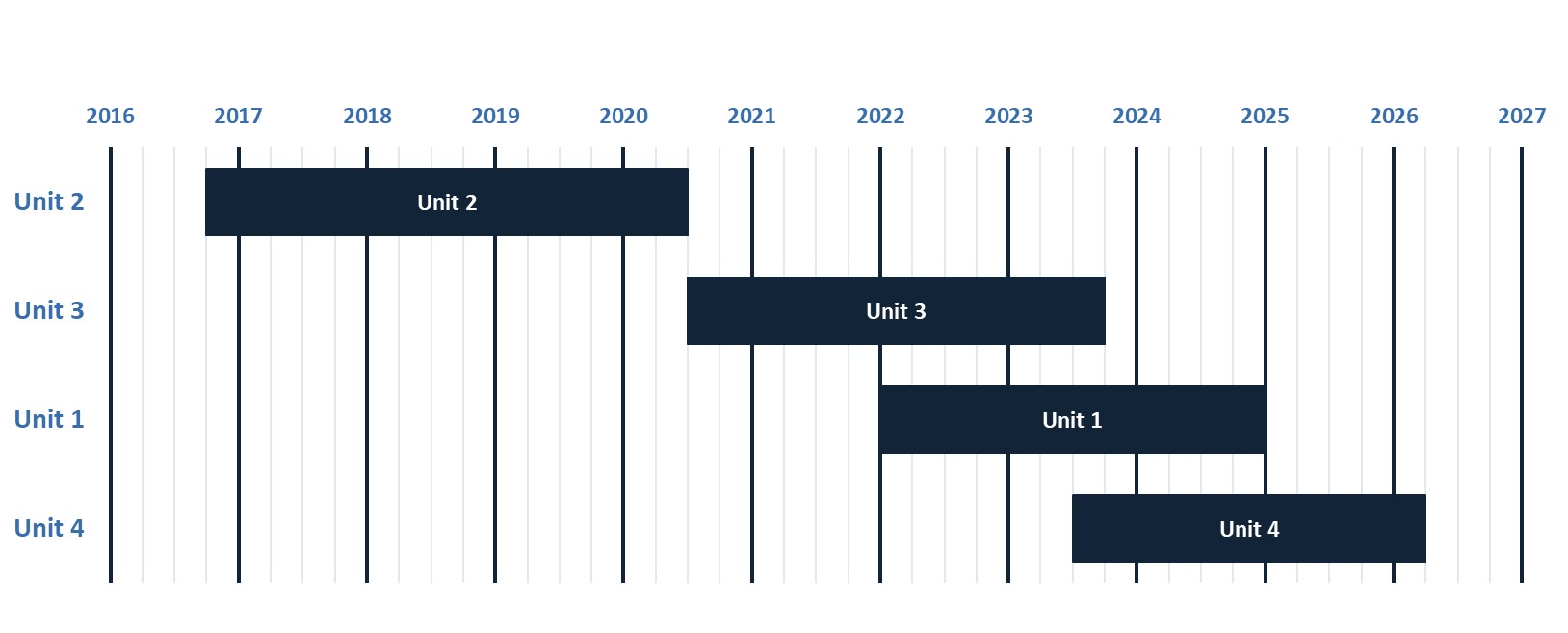
Figure 1 - Text version
Darlington Unit 2 from Q4 2016 to Q2 2020
Darlington Unit 3 from Q3 2020 to Q3 2023
Darlington Unit 1 from Q1 2022 to Q4 2024
Darlington Unit 4 from Q3 2023 to Q1 2026
In November 2022, OPG requested the removal of the first hold point to allow fuel to be loaded into Unit 3.
Next steps for Darlington
Unit 4, which is the last unit to be refurbished, is now progressing through the return-to-service phase of its refurbishment outage.
Our regulatory oversight is focused on confirming that prerequisites to remove the next of 4 RHPs have been met. Once all prerequisites for all 4 RHPs have been completed and verified by CNSC staff, OPG can return Unit 4 to service.
Upon return to service of Unit 4, all 4 units at the Darlington Nuclear Generating Station will have been refurbished.
For more information about refurbishment activities at Darlington:
Unit 4
Unit 3
Unit 2
Unit 1
Record of proceedings
Bruce A and B nuclear generating stations
Under licence condition 15.5 of the Bruce PROL (18.04/2028), Bruce Power is required to obtain approval from the CNSC for the removal of the pre-established RHPs before proceeding through the different phases of the return-to-service activities following refurbishment. In support of Bruce Power’s refurbishment project, the CNSC approved the deliverables and schedule for the activities needed to meet the prerequisites for releasing the RHPs.
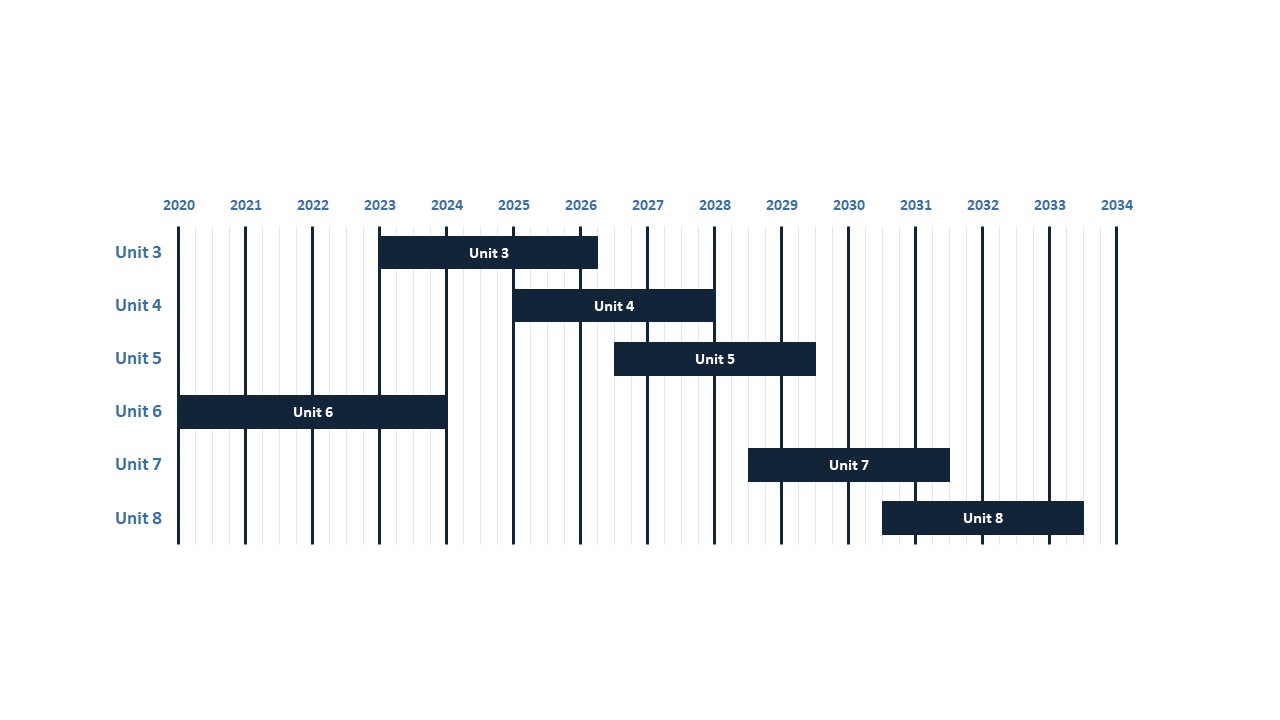
Figure 2 - Text version
Bruce Power Unit 3 from Q1 2023 to Q2 2026
Bruce Power Unit 4 from Q1 2025 to Q4 2027
Bruce Power Unit 5 from Q3 2026 to Q2 2029
Bruce Power Unit 6 from Q1 2020 to Q4 2023
Bruce Power Unit 7 from Q3 2028 to Q2 2031
Bruce Power Unit 8 from Q3 2030 to Q2 2033
Next steps for Bruce
Bruce Power is nearing completion of the Unit 3 Major Component Replacement (MCR) outage. New fuel channels, feeders and steam generators have been installed, and several other modification and maintenance activities have been carried out to improve safety and support reliable operation for an extended period. The next phase of the project will be to load fuel into the refurbished reactor and continue bringing systems back on line in a staged approach to allow graduated testing as the reactor is brought back to commercial operation.
The Bruce A Unit 4 MCR outage started in early 2025. Fuel has been removed and bulkheads have been installed to separate the reactor from the containment system. Work is underway to remove the major components, which will be followed by inspection and then installation of new components.
The Bruce B Unit 5 MCR is expected to begin in fall 2026.
For more information about the Bruce A and B nuclear generating station refurbishment, read:
Bruce B, Unit 6
As of September 9, 2023, all RHPs have been removed from Bruce B Unit 6, and the reactor has returned to full power operation.
CNSC staff continue to provide oversight of Unit 6 through the normal baseline compliance program.
Related links
Page details
- Date modified: